Pine whitepaper
How does a mobile bathhouse hook up? Power, water, and sewer
How a Pine mobile bathhouse connects to a property: the water, propane, power, and sewer connections it uses, what your property has to provide, and why it is operating in hours instead of a building season.
The short answer, then the real one
A Pine mobile bathhouse hooks up exactly the way a recreational vehicle does. Four standard connections: a garden-hose water connection for potable water in, a propane connection that feeds the hot water heater, a 50-amp plug for shore power, and RV sewer connections for waste out. That is the whole list. There is no plumbing to build, no foundation to pour, and no site work to schedule, because the unit arrives finished and connects to what your property already has.
The real answer is why that matters. Every one of those connections is the same quick-connect fitting the RV world has used for decades, which is the entire reason a mobile bathhouse can be taking guests the day it arrives instead of a construction season later. If your property already runs RV sites, you have seen all four connections a hundred times, and you already own most of what a unit needs. Below we walk through each connection in turn: what it is, what your property has to provide, and how quick it is in practice.
Water in by garden hose, hot water from a propane connection, power from a 50-amp plug, waste out through RV sewer connections. A property that already has an RV pedestal has three of the four in a single spot, and the unit connects in hours.
Water in: a standard garden-hose connection
Fresh water comes in through a standard threaded garden-hose connection, the same fitting you would use to fill an RV. Your property provides a potable water source within reach of the unit: a spigot, a yard hydrant, or the water outlet on an existing RV pedestal. Connect a hose, open the valve, and the bathhouse has pressurized water to every fixture.
Two practical notes we give every buyer. Use a hose rated for drinking water rather than an ordinary garden hose, and protect the connection against backflow. Any point where a drinking-water supply meets a fixture is what the EPA and your water authority call a cross-connection, and it is controlled with an inexpensive device such as a hose-bib vacuum breaker so water can only flow one way.[1] Campground sanitary codes make the same point from the other direction, requiring that potable water always be available and that nothing allow contaminated water to be drawn back into the supply.[4] None of this is unusual, it is the ordinary discipline of connecting any RV-style fixture to a water line, and it takes minutes.
Hot water: a propane connection
Hot water is heated on board by a propane water heater, and it connects through a standard propane connection. Your property provides the propane: a tank or a cylinder set placed near the unit, the same arrangement that fuels a cabin range, an RV, or a backyard heater. Propane is stored as a liquid under pressure and delivered through a regulator to the appliance,[2] so the supply is compact and does not depend on a gas main.
We run hot water on propane deliberately. It keeps the unit independent of whatever heating fuel a property does or does not have, it recovers fast enough to hold up against the sunrise shower wave that governs a campground morning (the demand pattern we cover in how many bathrooms a campground needs), and a tank is trivial to top off on a schedule. As with any fuel-burning appliance, have the connection made and leak-checked by a qualified propane technician, and keep the space it vents to clear. The connection itself is standard and quick; the safety discipline around it is the same you would apply to any propane appliance.
Power: a 50-amp shore-power plug
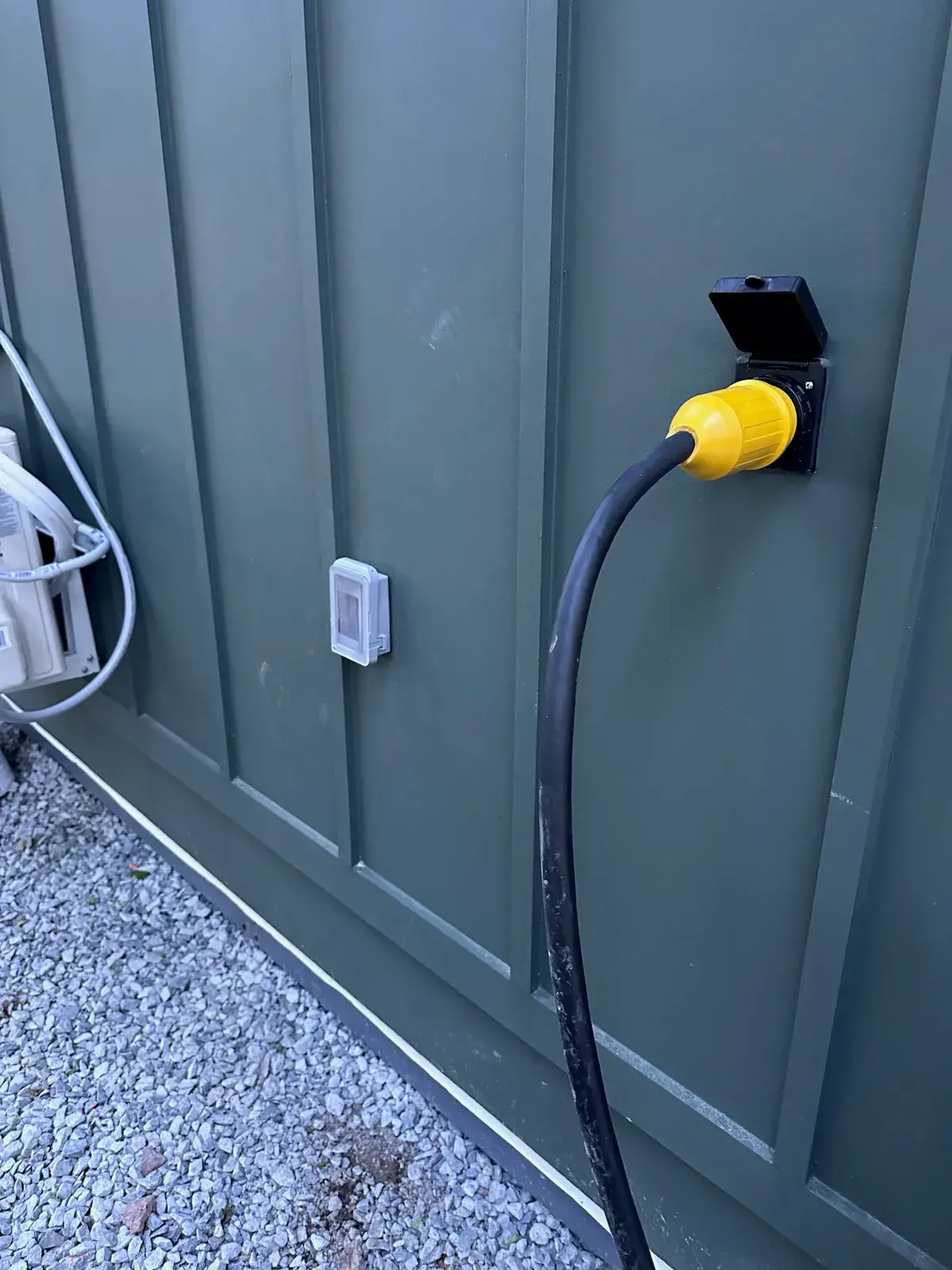
Electrical service comes in through a 50-amp shore-power plug, the same 120/240-volt connection a large RV uses. Your property provides a 50-amp receptacle, typically the pedestal at an RV site. Plug it in and the unit has power to lights, fans, pumps, the water heater controls, and the smart hardware Pine builds into every space.
The receptacle side is the part worth getting an inspector on. RV park power is governed by the National Electrical Code (NFPA 70), which sets how 50-amp sites are wired, requires ground-fault protection, and, in recent editions, weather-resistant receptacles on 30- and 50-amp circuits.[3] If your property already has a compliant 50-amp RV pedestal, the bathhouse plugs into it directly. If you are adding a pedestal, have a licensed electrician install it to your adopted code before delivery. The connection on the bathhouse end is the standard shore-power plug pictured above; the work, if any, is on the pedestal, not the unit.
Waste out: standard RV sewer connections
Waste leaves through RV sewer connections, exactly like other standard RVs. Both greywater from the showers and sinks and blackwater from the toilets route to a standard sewer hose that connects to your sewer inlet, a septic connection sized for the load, or a dump connection serviced on an interval. Your property provides the destination; the unit provides the standard fittings.
This is the same model campgrounds already run for RV sites, and the same code framework applies. State sanitary rules for camping areas set how individual sewer connections are made, cap flow at a per-site allowance, and require that each connection be tightly capped when nothing is connected to it.[4] Confirm with your county health department how it wants a fixed bathhouse tied in, since a unit that stays in one place all season is often treated a little differently from a transient RV. The connection is standard RV hardware either way, and if you host RVs today you already have the destination it needs.
Every connection at a glance
Four connections, and what each one asks of your property:
| Connection | What it is | What the property provides |
|---|---|---|
| Water in | Standard threaded garden-hose connection for potable water | A potable spigot, hydrant, or pedestal water outlet, plus backflow protection |
| Hot water | Propane connection feeding an onboard water heater | A propane tank or cylinder set, connected by a qualified technician |
| Power | 50-amp, 120/240-volt shore-power plug | A code-compliant 50-amp RV receptacle or pedestal |
| Waste out | Standard RV sewer connections (grey and black) | A sewer inlet, sized septic connection, or serviced dump connection |
An existing RV pedestal delivers water, power, and sewer at one point, which is why properties that already host RVs get a bathhouse online fastest. The details of what a full property needs, beyond the bathhouse itself, are in campgrounds and resorts, and the smart hardware that rides on the power connection is covered in Pine hardware and network.
No hookups where you are placing it?
Not every location has a pedestal waiting. The standard connections above are the fastest path, but a unit can also run with less. Power can come from a generator or a solar setup instead of a 50-amp pedestal, and water and waste can run off onboard tanks for a while instead of a permanent connection.
Be honest with yourself about scale, because it decides what is practical. A single-stall Bath Pod is built to run fully self-contained on onboard fresh and waste tanks, serviced on a routine interval, which suits a remote site or a first cabin on raw land. A three- or four-shower mobile bathhouse is a different animal: at that many showers, tanks fill far too quickly to be practical, so a larger unit really does want a real water and sewer source. If you are leaning on a generator, size it for the load and follow the safety basics, because portable generators are a leading cause of carbon monoxide poisoning and must run well away from any occupied space.[5] We go deep on the off-grid tradeoffs, tank intervals, and power options in off-grid utilities for cabins and bathhouses.
Standard connections keep it a titled RV asset
There is a reason we design around RV-style connections and counsel every buyer to keep them that way. A Pine mobile bathhouse is a titled RV asset on a steel chassis, delivered as mobile equipment. The instinct some owners have, to hardwire it into the building electrical panel or hard-plumb it into septic and water lines, works against that. Permanently connecting a mobile unit can change how a local authority classifies it, from mobile equipment to a permanent structure, and that reclassification reopens exactly the zoning and permitting questions the mobile approach was chosen to avoid.
No one would hardwire and hard-plumb a recreational vehicle into a building; the same logic protects a mobile bathhouse. Standard connections keep the unit what it is, keep it movable, and keep the setup simple enough to reverse or reposition when your property changes. How a titled, movable asset is treated differently from real property is its own subject, covered in titled asset versus real property. Pine does not provide legal advice; confirm classification with your local authority.
Working out the connections for a specific property? Build & Price lets you configure a bathhouse and see transparent, distance-based delivery, and if you would rather talk it through against your site, that is what we are here for.
Frequently asked questions
- How does a mobile bathhouse hook up?
- It connects exactly the way a recreational vehicle does, through four standard connections: a garden-hose water connection for potable water in, a propane connection that feeds the hot water heater, a 50-amp plug for shore power, and RV sewer connections for waste out. There is no plumbing to build, no foundation, and no site work. If your property already hosts RVs, it already has everything a unit needs, and a bathhouse can be operating the same day it arrives.
- What does my property need to provide before delivery?
- A potable water spigot, a propane supply (a tank or cylinder set), a 50-amp RV receptacle, and a place for waste, either an RV sewer inlet, a septic connection sized for it, or a dump connection on a service interval. An RV pedestal that already carries power, water, and sewer covers three of the four in one spot. Confirm your local requirements with your county health department and electrical inspector before you build.
- How long does the hookup take?
- Hours, not weeks. The connections are the same quick-connect fittings an RV uses, so once the unit is set and leveled, connecting water, propane, power, and sewer is measured in hours. The long timeline in a site-built bathhouse comes from foundation, permits, and on-site plumbing, none of which a mobile bathhouse needs.
- Can it run without water and sewer hookups?
- A single-stall Bath Pod can run fully self-contained on onboard fresh and waste tanks, serviced on a routine interval, and power can come from a generator or solar where there is no pedestal. A three- or four-shower bathhouse fills tanks far too quickly for that to be practical, so larger units are designed for the standard RV connections and a real water and sewer source.
- Can I hardwire or hard-plumb it into my building utilities?
- We advise against it. Permanently wiring or plumbing a mobile unit into your building systems can change how your local authority classifies it, from mobile equipment to a permanent structure, which reopens the zoning and permitting questions the mobile approach avoids. Standard RV-style connections keep it classified as what it is.
- Do I need a special hose for the water connection?
- Use a potable-water-rated hose, not an ordinary garden hose, and protect the connection against backflow. Health codes and the EPA treat any connection between a drinking-water supply and a fixture as a cross-connection to be controlled, commonly with a hose-bib vacuum breaker. Your water authority can tell you what it requires.
Sources
- Cross-Connection Control Manual. U.S. Environmental Protection Agency.
- Propane basics. Alternative Fuels Data Center, U.S. Department of Energy.
- Understanding NFPA 70, National Electrical Code (NEC). National Fire Protection Association.
- General requirements for recreational camping areas. Minnesota Department of Health.
- Portable generators pose a serious carbon monoxide hazard. U.S. Consumer Product Safety Commission.
This paper describes how Pine mobile bathhouses are built to connect, drawn from manufacturing and delivering these units and observing them in operation. The four connections (garden-hose water in, propane to the water heater, 50-amp shore power, and RV sewer out) are standard equipment. Fixture minimums, electrical inspection, backflow protection, and sanitary requirements are jurisdiction-specific; confirm them with your county health department and electrical inspector before you build. Pine does not provide legal advice.
Working through this for a specific property?
Build & Price