Pine whitepaper
How do you run a property with no utilities at the lot line?
A Pine field guide to running a guest property when nothing is stubbed to the lot: how to think about power, water, waste, and connectivity, in what order to solve them, and where the honest tradeoffs live.
The short answer, then the real one
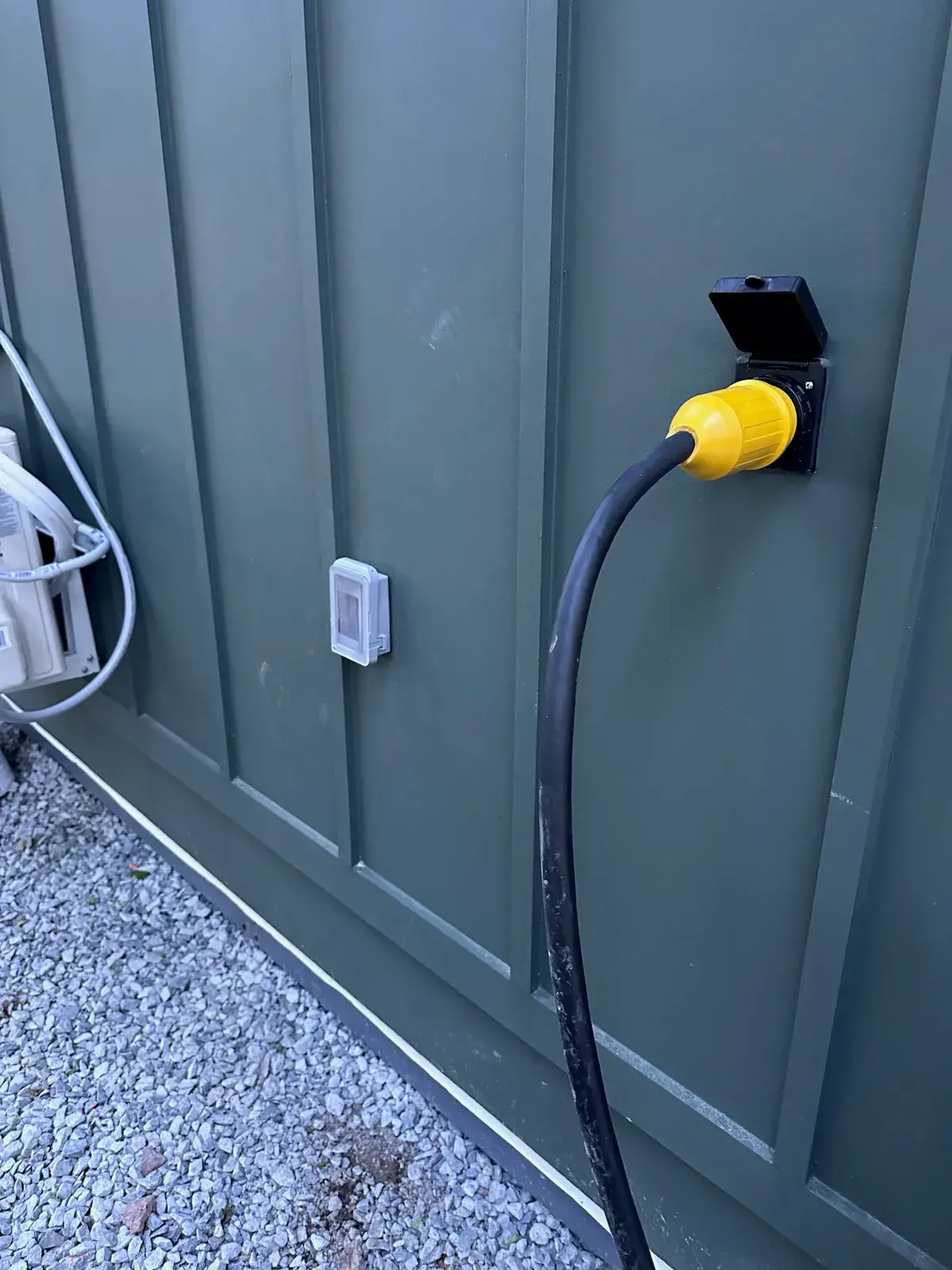
You can run a full guest property with nothing stubbed to the lot, and it is less exotic than it sounds. Every plumbed Pine space arrives finished with standard RV-style power, water, and sewer connections, and the Plus and the Bath Pod carry their own onboard freshwater, grey, and black tanks, so a first cabin and its bath are self-contained the day they land. What "off-grid" actually asks of you is four decisions, one per utility: how you make power, where the water comes from, where the waste goes, and how a signal reaches the property. None of the four is hard. The mistake is treating them as one problem, or copying a neighbor's setup without matching it to how many nights a year you plan to run.
Power: solar-plus-battery, a generator, a pedestal tie-in, or a hybrid. Water: onboard tanks, a drilled well, or delivered water. Waste: onboard grey and black tanks on a pump-out interval, a septic field, or a composting toilet. Connectivity: one internet drop at a powered building, extended to the spaces over Pine's dedicated long-range network.
The rest of this guide takes the four one at a time, with the honest tradeoffs and the numbers that actually move the decision, then closes with sequencing: what to solve first so you do not dig a trench you did not need or drill a well you could have skipped. Two caveats belong up top. Wells, septic systems, and generator placement are regulated locally, so every specific rule below is a starting point to confirm with your township and a licensed installer, not a promise. And every number here is offered as planning guidance from what we see in the field, not as an engineering spec for your particular lot.
Why "off-grid" is the wrong mental model
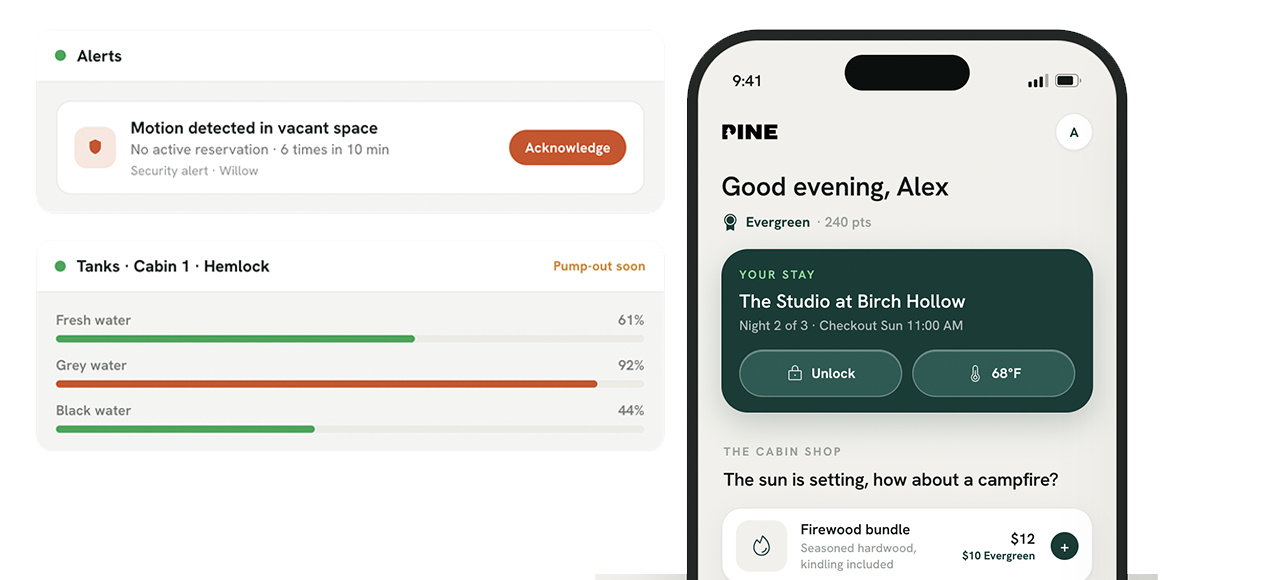
The phrase "off-grid" makes people picture a single fragile system that either works or fails for the whole property. That is the opposite of how a Pine property behaves, and getting the mental model right changes every decision that follows. Each space is local-first: it carries its own onboard controller, so the smart lock, the climate control, and the safety sensors run on the cabin itself, not on a live link to anything. A space does not go dark or lock a guest out because a wire to the property office came loose or the satellite dropped for an hour.
That design is deliberate, and it is what makes the utility question manageable. Because each cabin is independent, you are not building one big central plant that everything depends on. You are feeding several self-sufficient spaces, and you can feed them by different means in different parts of the property: a lakeside pair on solar, a cluster near the entrance on a pedestal tie-in, a shared bathhouse on its own service. The failure of any one feed is contained to the spaces it serves. Through the deliveries we have made to raw land, this is the single idea that separates the operators who sleep well from the ones who chase gremlins: solve utilities per zone, not per property, and let each space stand on its own.
It also reframes the trailer question people ask us. These are not RVs you tow in and plug into a campground pedestal every night. They are finished, titled assets that sit in place and connect to whatever you build for them. The onboard tanks and RV-style hookups are not a limitation, they are the reason the property works before you have poured a single foundation. If you want the full picture of the controller, the sensors, and the network that make a space local-first, that lives on the Pine Base Station and hardware page.
Power: solar and battery, a generator, or a pedestal
Power is the decision most shaped by how hard you plan to run the property, and the honest answer for most operators is a hybrid rather than a single source. There are three feeds, and they are not equivalent in cost, reliability, or upkeep.
Solar plus battery. A photovoltaic array with battery storage is the quietest, lowest-running-cost option, and the U.S. Department of Energy documents solar-plus-storage as a mature residential approach: the panels charge the battery, and the battery carries the load after dark.[1] For light seasonal use, a modest array sized to your real evening load is often the lowest total cost of anything on this list, because after the install there is almost no running cost and no fuel to haul. The tradeoff is honest and physical: solar output falls in a run of cloudy days and in the short light of a northern winter, so a system sized for a July weekend can come up short in November. Size the battery for your worst realistic stretch, not your average day, and treat air conditioning and electric hot water as the loads that decide how big the array has to be.
Generator. A generator delivers power on demand regardless of weather, which is why it remains the backbone for heavy or year-round use, and it pairs well with solar to cut runtime and fuel. The tradeoffs are running cost, noise, and, above all, safety. Generator exhaust is carbon monoxide, and the Consumer Product Safety Commission is unambiguous that portable generators must run outdoors only, well away from windows, doors, and vents, with working CO alarms in any occupied space nearby.[2] On a guest property that safety point is not optional fine print, it is a design constraint: plan generator placement, exhaust direction, and separation from sleeping spaces before anything is installed, and put it in your house rules.
Pedestal tie-in. If utility power reaches any part of the property, even a single building, you can often extend a proper feed to a pedestal and connect a space the way it connects at any RV site: through a standard power pedestal. This is the simplest feed of the three when the service is there, and it is worth pricing the run before you assume you are fully off-grid, because "no utilities at the lot line" and "no utilities anywhere on the parcel" are different situations. Where the service exists but is undersized, a small solar or generator assist can cover the peaks without a costly utility upgrade.
Water: onboard tanks, a well, or hauled water
Water has three sources, and the right one is mostly a question of scale and how long you want to wait to open. Because the plumbed spaces carry an onboard freshwater tank, you have a working option before you commit to any infrastructure at all.
Onboard tanks with delivered or hauled water. The fastest path to open is to run on the onboard freshwater tank and refill it, either from a delivery service or from a source elsewhere on the property. This is how a lot of smaller programs we deliver to start: no drilling, no permit, no timeline, and you learn your real consumption before you spend on anything permanent. The tradeoff is the refill logistics, which get heavier as you add spaces and as showers get longer, which is exactly why a shared mobile bathhouse is usually plumbed to a steadier supply rather than run on tanks alone.
A drilled well. At larger scale, a well becomes the low-per-gallon option and removes the refill chore. Two honest cautions. First, a well is a drilling project with a permit and an uncertain yield until it is in, so it belongs in your early township conversation, not a late one. Second, private wells are not covered by the federal rules that govern public water, so the owner is responsible for testing: the CDC recommends testing at least once a year for total coliform bacteria, nitrates, total dissolved solids, and pH, plus whatever your local health department flags for your area.[3] On a property serving paying guests, that testing discipline is not a nicety, it is part of running the place.
Where it lands. Most operators we see start on onboard tanks and delivered water to open on schedule, then add a well only when the site count justifies the drilling. The single Bath Pod is designed to run fully self-contained on its onboard tanks for exactly this reason: it lets a first cabin have a real bathroom before there is any water infrastructure at all.
Waste: tanks, pump-out, and the composting question
Waste is where the biggest myth lives, that you need a septic field to host anyone. You do not. The Plus and the Bath Pod carry onboard grey and black tanks with standard RV-style sewer connections, so the baseline is the one every RV park already runs: hold it, then pump it out on a schedule. There are three ways to handle it, and the right one tracks your scale.
Onboard tanks on a pump-out interval. For most small and mid-size programs this is the workhorse. The space holds grey and black water in its onboard tanks and a service pumps them on a routine interval, the same holding-tank model many rural jurisdictions permit where a conventional field is not practical. The tradeoff is honest and it scales with fixtures: a low-use cabin can go a long interval between pump-outs, while a three- or four-shower shared bathhouse fills far too fast for tanks alone to be practical, which is why larger shared spaces are designed for a steadier sewer connection instead of a pump-out schedule that would not survive a busy weekend. Match the servicing model to the fixture count, and press any vendor who glosses over it.
A permitted septic system. At larger or permanent scale, an onsite septic system can lower the per-use cost and remove the pump-out logistics, and the EPA catalogs the conventional and alternative system types.[4] It is also the most regulated and slowest path here: soil testing, a permit, and a build timeline, all jurisdiction-specific. Treat it the way you would a well, as a scale decision to plan early, not a default.
Composting toilets. Dry and composting toilets are fully off-grid and cut both water use and black-tank volume, and the EPA documents them as an established alternative technology.[5] Here is the unvarnished version. A composting unit needs regular, correct servicing to stay pleasant, and, more decisively, an upscale guest paying a lodging rate expects a flush toilet. For most revenue-focused properties we steer toward onboard black tanks with scheduled pump-out and reserve composting for truly remote or intentionally rustic positioning, where the off-grid story is part of what the guest is paying for rather than a compromise they notice.
Connectivity: one internet drop, extended out
Connectivity is the utility operators worry about most and the one Pine solves most directly. You do not need internet service run to every cabin. You need exactly one internet source at one powered building, a lodge, an office, a house, by whatever means reaches your property: fixed wireless, satellite, or a cellular gateway. That is the whole requirement.
From there, the Pine Base Station plugs into that internet connection and extends Pine's dedicated long-range network out to the spaces. The individual cabins do not each need their own wifi, cellular plan, or wired run; they talk to the base over a network built for distance and obstructions, which is what makes a wooded or spread-out property workable without trenching data lines everywhere. If the only place with power and a signal is your house at the road, that is enough to reach cabins well back on the parcel.
A dropped internet link is not a dark cabin. Because every space is local-first, its lock, climate, and sensors run on the space itself. When the property's single internet source blips, remote monitoring pauses and catches up when it returns, and the guest never notices. That is the point of not depending on utilities you do not control.
This is also where the property earns its keep operationally. Once the spaces are on the network, the same connection carries the readings and controls an operator runs the property from, without replacing the booking calendar you already use. The full operator picture lives on the Innkeeper page; for this guide the relevant fact is narrower. One internet drop, extended by the base station, is the entire connectivity project.
The four utilities, side by side
Here is the whole decision on one screen. Read the tradeoff column as the thing operators most often underweight at planning time, not as a reason to avoid an option.
| Utility | Off-grid options | The honest tradeoff |
|---|---|---|
| Power | Solar plus battery; generator; pedestal tie-in; hybrid | Solar is cheapest to run but weakest in cloudy or short-day stretches; generators are reliable but need fuel and strict CO-safe placement; a pedestal tie-in is simplest where service already reaches the parcel |
| Water | Onboard freshwater tank with delivered water; drilled well | Tanks open fast with no permit but carry refill logistics that grow with use; a well lowers per-gallon cost but is a permitted drilling project with owner-run annual testing |
| Waste | Onboard grey and black tanks on pump-out; permitted septic; composting toilet | Tanks and pump-out fit most programs but fill fast at high shower counts; septic lowers cost at scale but is the slowest permit; composting is truly off-grid but needs upkeep and lowers guest expectation |
| Connectivity | One internet drop at a powered building, extended over Pine's dedicated long-range network | You need a signal at exactly one spot with power; spaces stay local-first, so a dropped link pauses monitoring but never locks a guest out or kills a cabin |
Sequencing: what to solve, and in what order
The costliest mistakes on raw land are not wrong choices, they are choices made in the wrong order: a trench dug before the cabin locations were final, a well drilled before anyone measured real consumption. A better sequence saves both.
First, settle where the spaces actually go, because every utility run is priced off distance and every one gets cheaper when the layout is fixed. Second, take your permitting questions to the township before you commit to a well, a septic field, or anything that changes how the property is classified; the questions worth asking are laid out in our guide to the questions to ask your township before you build. Third, find your one internet source and place the base station, since that unlocks the operator tools you will use to run everything else. Fourth, open on the fast, low-commitment versions of power, water, and waste, solar or a pedestal, onboard tanks, scheduled pump-out, and let a real season teach you your actual loads. Only then, fifth, invest in the permanent infrastructure that a proven site count justifies: a bigger array, a well, a septic system.
That order works because a Pine property is productive at every step, not only at the end. A first cabin can take guests on onboard tanks and a pedestal while you are still deciding whether a well pencils, which means the property is earning while you learn instead of sitting idle behind a construction timeline. Operators planning a property from scratch can start that conversation on the landowners and new operators page, and when the layout is set, the Build & Price tool turns a specific site plan into a specific configuration. The land with no utilities at the lot line is not the obstacle it looks like. It is the reason the whole approach exists.
Frequently asked questions
- Can you really run a rental cabin with no utilities at the lot line?
- Yes. Every plumbed Pine space arrives finished with RV-style power, water, and sewer connections, the Plus and the Bath Pod carry their own onboard freshwater, grey, and black tanks, and the unplumbed Pod and Camp pair with a Bath Pod or bathhouse, so a property can operate self-contained from day one. The practical question is not whether it runs without utilities but how you feed and empty it: power from solar-plus-battery, a generator, or a pedestal tie-in; water from onboard tanks, a well, or delivered water; and waste from onboard tanks on a pump-out interval. Confirm well, septic, and generator rules with your local authority before you build, since those are set locally.
- What is the cheapest way to power an off-grid guest cabin?
- It depends on how many nights a year you run. For light seasonal use, a modest solar array with a battery is usually the lowest total cost because it has almost no running cost and no fuel deliveries. For heavy or year-round use with real HVAC and hot-water load, a generator or a pedestal tie-in to whatever service reaches part of the property tends to be more reliable, often paired with solar to cut runtime. Most operators we work with end up with a hybrid rather than a single source.
- Do I need a well and a septic system for a Pine property?
- Not necessarily. A plumbed Pine space connects the way a recreational vehicle does, and the Plus and the Bath Pod carry onboard freshwater and waste tanks, so a well and a permitted septic field are options, not requirements. Smaller programs often run on onboard tanks with delivered water and scheduled pump-out, which avoids the drilling, the permit, and the timeline. A well or septic can make sense at larger scale, but both are jurisdiction-specific and belong in your township conversation early.
- Are composting toilets a good idea for a rental?
- Sometimes, but go in clear-eyed. Composting and other dry toilets are fully off-grid and cut water and black-tank demand, and the EPA documents them as an established alternative technology. The tradeoff is guest expectation and hands-on maintenance: an upscale, premium-paying guest expects a flush toilet, and a composting unit needs regular, correct servicing to stay pleasant. For most revenue-focused properties we favor onboard black tanks with scheduled pump-out and reserve composting for truly remote or rustic positioning.
- How does internet work at a property with no service?
- The property needs exactly one internet source at a building that has power, a lodge, office, or house, by any means that reaches it: fixed wireless, satellite, or a cellular gateway. The Pine Base Station plugs into that connection and extends Pine’s dedicated long-range network out to the spaces, so the individual cabins do not each need their own wifi or cellular run. Each space is local-first, so its lock, climate, and sensors keep working even if the internet link drops.
- What happens to the smart features if the power or internet goes out?
- They keep working locally. Each Pine space has its own onboard controller, so the lock, climate control, and safety sensors operate on the space itself rather than depending on a live connection to the internet or a central hub. If the property’s internet drops, remote monitoring pauses and catches up when the link returns, but a guest is never locked out and the space is never dark because of it. This local-first design is the whole point of not depending on utilities you do not control.
Sources
- Homeowner’s guide to going solar (solar-plus-storage basics). U.S. Department of Energy.
- Generators and engine-driven tools: carbon monoxide safety. U.S. Consumer Product Safety Commission.
- Guidelines for testing private well water. U.S. Centers for Disease Control and Prevention.
- Types of septic systems, including conventional and alternative systems. U.S. Environmental Protection Agency.
- Water-efficiency technology fact sheets, including composting toilets. U.S. Environmental Protection Agency.
This guide draws on Pine’s experience building, delivering, and connecting self-contained spaces on properties with no utilities at the lot line, alongside cited government guidance on solar-plus-storage, generator safety, private well testing, and onsite waste treatment. Off-grid power sizing, well and septic permitting, and generator placement are governed by local codes and site conditions; confirm every one with your local authority, a licensed installer, and the cited agencies before you build. Pine does not provide engineering, legal, or code-compliance advice.
Working through this for a specific property?
Build & Price