Pine whitepaper
Do glamping domes have bathrooms? How to add one.
Most domes and safari tents arrive without a bathroom, so the operator adds one. Here are the four honest ways to do it, what each costs you in permits and guest experience, and the delivered path that connects in hours.
The short answer, then the real one
No. In our experience, the overwhelming majority of geodesic domes and safari tents do not come with a bathroom, and buyers are usually surprised by that. What a dome maker sells is a shelter: a frame, a weatherproof cover, and often a deck, heating, and furniture. The bathroom is a separate project the operator has to plan, pay for, and connect. That is the real question hiding inside “do glamping domes have bathrooms,” and it is the one that decides whether your property reads as camping or as lodging.
Domes and tents are shelters, not plumbed rooms. You add the bathroom, and you have four honest ways to do it: a shared bathhouse, private plumbing per unit, a composting or portable stopgap, or a delivered self-contained bath that connects like an RV. The last one is the bathroom this whole category has been missing.
Below we explain why soft structures ship without plumbing, lay the four options side by side on permits, site work, and guest experience, and then get specific about the delivered path, because it is the one that removes the permitting and construction project entirely. This is a companion to our deeper piece on sizing a campground bathhouse to real demand; here the focus is the dome and tent operator who is starting from no bathroom at all.
Why domes and safari tents arrive without plumbing
A soft-shell structure is engineered around its envelope. A dome is a strut-and-membrane system; a safari tent is a canvas skin on a frame. Neither has the wet walls, the vented waste stack, or the insulated, freeze-protected chases that a plumbed bathroom needs, and adding them to a fabric building is awkward at best. So the manufacturers do the sensible thing and leave plumbing out, which keeps the structure light, shippable, and cheaper to buy. The bathroom becomes site work, and site work is exactly where an outdoor-hospitality budget tends to slip.
That matters more now than it used to, because the guest showing up has changed. Outdoor recreation is a large and growing market: the U.S. outdoor-recreation economy generated $639.5 billion in value added in 2023, about 2.3 percent of GDP, and it grew faster than the overall economy that year.[5] Many of the guests behind those numbers are not tent campers trading comfort for price. They are paying a lodging rate and expecting a lodging bathroom: a hot shower, a real toilet, a place to get ready. A dome with no bathroom, or a long robe-walk to a cinderblock facility, is the detail that shows up in the review.
There is a public-health floor under all of this too. Handwashing prevents roughly 30 percent of diarrhea-related illness and about 20 percent of respiratory infections, which is precisely why every state sets minimum sanitary-facility requirements for guest properties.[2] Michigan, for example, publishes a fixture schedule that scales toilets and lavatories to the number of sites, starting at one toilet and one lavatory per sex for the smallest campgrounds.[1] Your jurisdiction has its own version, and it is a floor, not a target. The bathroom is not optional; the only real question is how you provide it.
Four ways to add a bathroom, and their real tradeoffs
The four paths are not equivalent, and the differences that matter are rarely the fixtures. They are timeline, permitting, site work, and what the guest actually experiences. Here they are side by side.
| Bathroom option | Privacy | Permits & site work | Guest experience |
|---|---|---|---|
| Shared site-built bathhouse | Shared, walk to it | Building permit, foundation, trenched water and sewer, months of construction | Good when well sized and close; a robe-walk when it is not |
| Private plumbing run to each unit | Fully private, per unit | Permit plus trenching, and a septic or sewer connection for every dome; the most site work | Best in class, and the most expensive path by a wide margin |
| Composting or portable toilet | Private cabin or shared, varies | Minimal structure permitting; ongoing servicing and maintenance | Functional, off-grid friendly, but not the finished bathroom an upscale guest expects |
| Delivered self-contained bath | Private (Bath Pod) or shared (mobile bathhouse) | No foundation or building permit for the structure; RV-style hookup, operating in hours | Finished, plumbed, private; the closest thing to an ensuite without the ensuite project |
Read down the permits column and the pattern is obvious: the two site-built paths buy you permanence at the cost of a permitting-and-construction project, and for a seasonal operator that timeline is not a scheduling detail, it is a lost season. The composting path avoids the project but spends the difference on guest experience. The delivered bath is the one that keeps the finished-bathroom result while removing the project, which is why we build in that lane and why the rest of this paper spends the most time there.
Shared or private? It depends where guests sleep
Before the structural choice, settle the layout question, because it changes everything downstream. The organizing principle we give every operator is simple: private where guests sleep, shared where they gather.
A private bathroom is much of what separates a camping rate from a lodging rate. The mental model is a vacation rental, not a campground: a three-bedroom house with one well-appointed bathroom hosts a family comfortably for a week and no one calls it under-provisioned, because the bathroom belongs to them. A dome or a small cluster of domes with its own dedicated bath does the same thing, and it lets you charge accordingly. That is the case for putting a private bath on your premium units.
Shared bathhouses do not disappear in this model; they relocate. Near the common areas, the firepit, the gathering lawn, a multi-stall bathhouse absorbs the social peaks and serves the walk-up traffic that a private unit should not have to. If you are sizing that shared capacity, the binding constraint is showers rather than toilets, because shower demand concentrates into the two hours after sunrise while toilet demand spreads across the day. We work through that math in detail in the campground bathhouse sizing guide. For a dome property specifically, most operators end up running both: private baths on the flagship units, a shared bathhouse where people congregate.
The composting and portable stopgap, honestly
Composting and portable toilets deserve an honest hearing, because they are a real answer for the right property. A composting toilet needs little or no water and no sewer connection, breaks waste down to a fraction of its original volume, and has been an established sanitation technology in unsewered and rural areas for decades.[4] For a genuinely off-grid or deliberately primitive site, that is a feature, not a compromise, and it pairs well with the broader question of running a property with no utilities at the lot line.
The tradeoff is the one you would expect. These units solve compliance and can be stood up quickly, but they do not deliver the finished, private, heated bathroom that a guest paying an upscale rate has in mind. A composting toilet still needs a handwashing station beside it, since hand hygiene is where the actual public-health benefit lives.[2] And a portable unit rented by the month carries a servicing schedule and a look that fights the brand you are trying to build. Our honest read: use composting or portable facilities as a stopgap while you plan a permanent path, or on primitive sites you have priced as primitive, not as the bathroom for a premium dome you are asking a lodging rate for.
The bathroom the category is missing
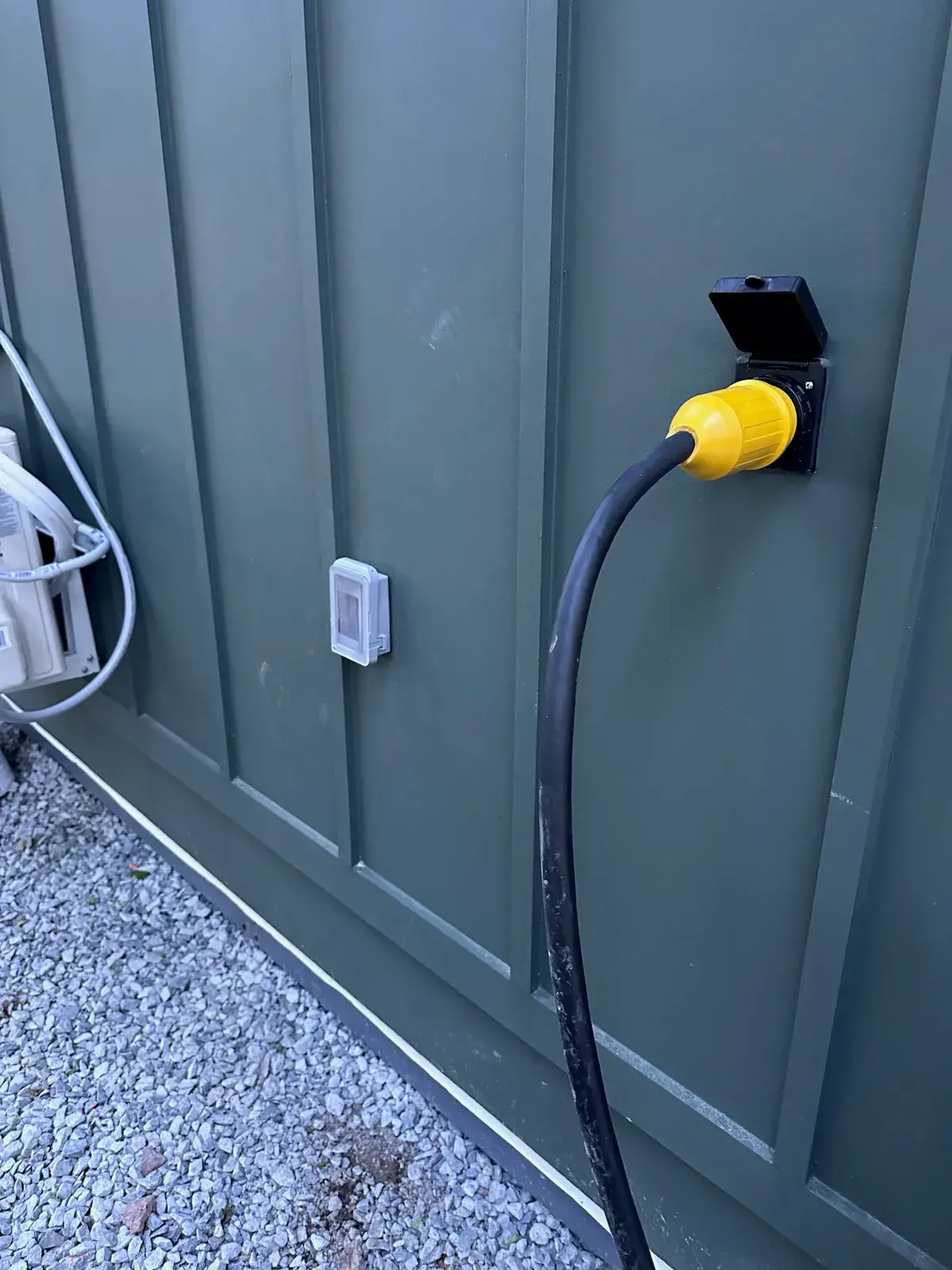
Here is where we build, so read the rest knowing that. The gap in the dome and tent market is a bathroom that arrives finished and connects without a construction project, and that is exactly what a delivered, self-contained bath is. It ships built and titled as a movable asset on a steel chassis, then connects to a property the way a recreational vehicle does, through a standard power pedestal, a water connection, and a sewer connection. No foundation. No building permit for the structure. No months of trenching and inspections. If your property already hosts RVs or has a pedestal, you already have most of what a unit needs, and it can be taking guests within days of arriving.
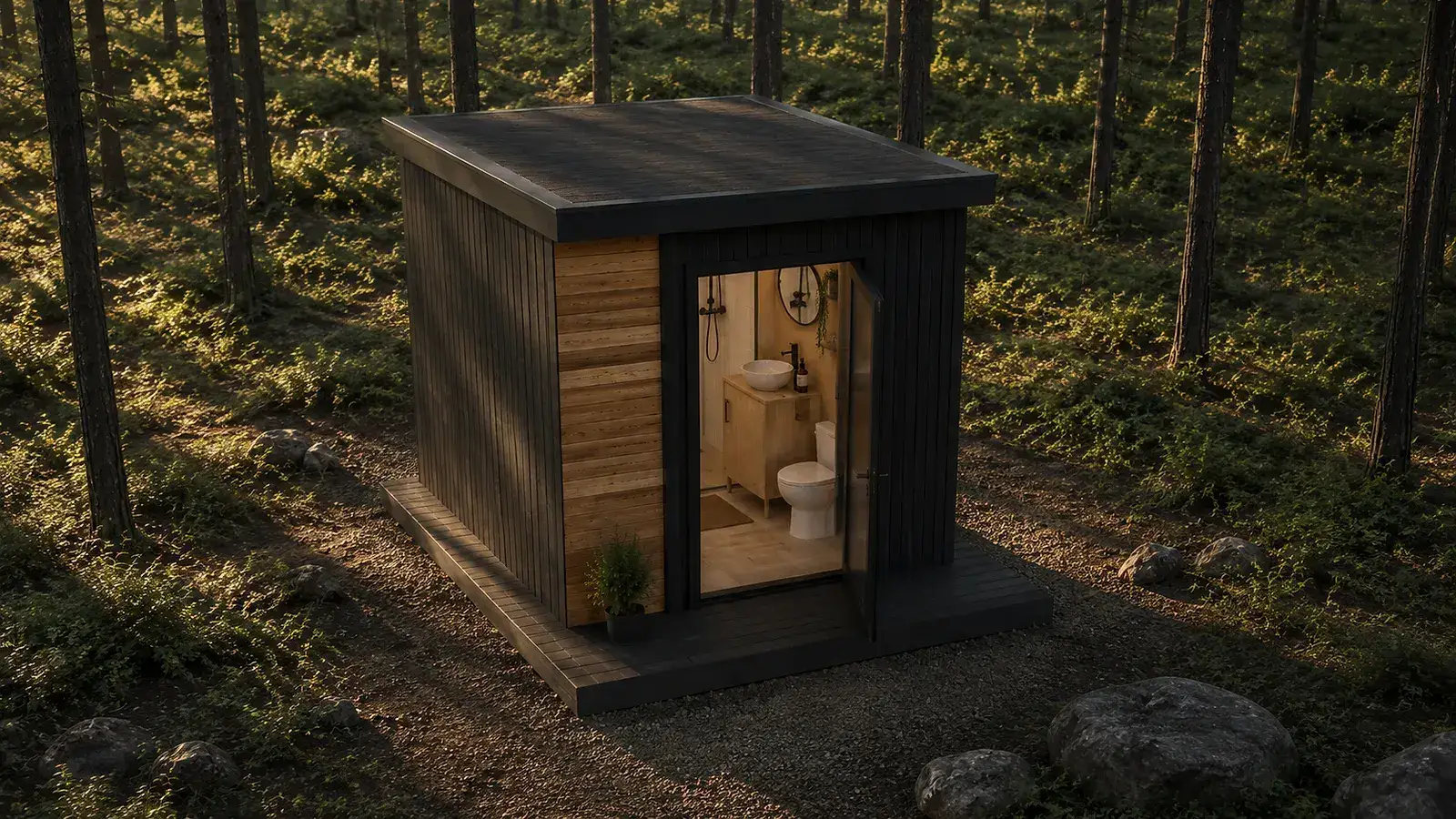
A finished private bathroom: a rain shower, a vanity, and a toilet, with all fresh and waste tanks on board. It serves up to three nearby units, so a small cluster of domes or tents shares a real bathroom without plumbing run to each one. For a whole gathering area or a field of sites, a multi-stall mobile bathhouse covers the cluster. Both connect through standard RV-style hookups, in hours.
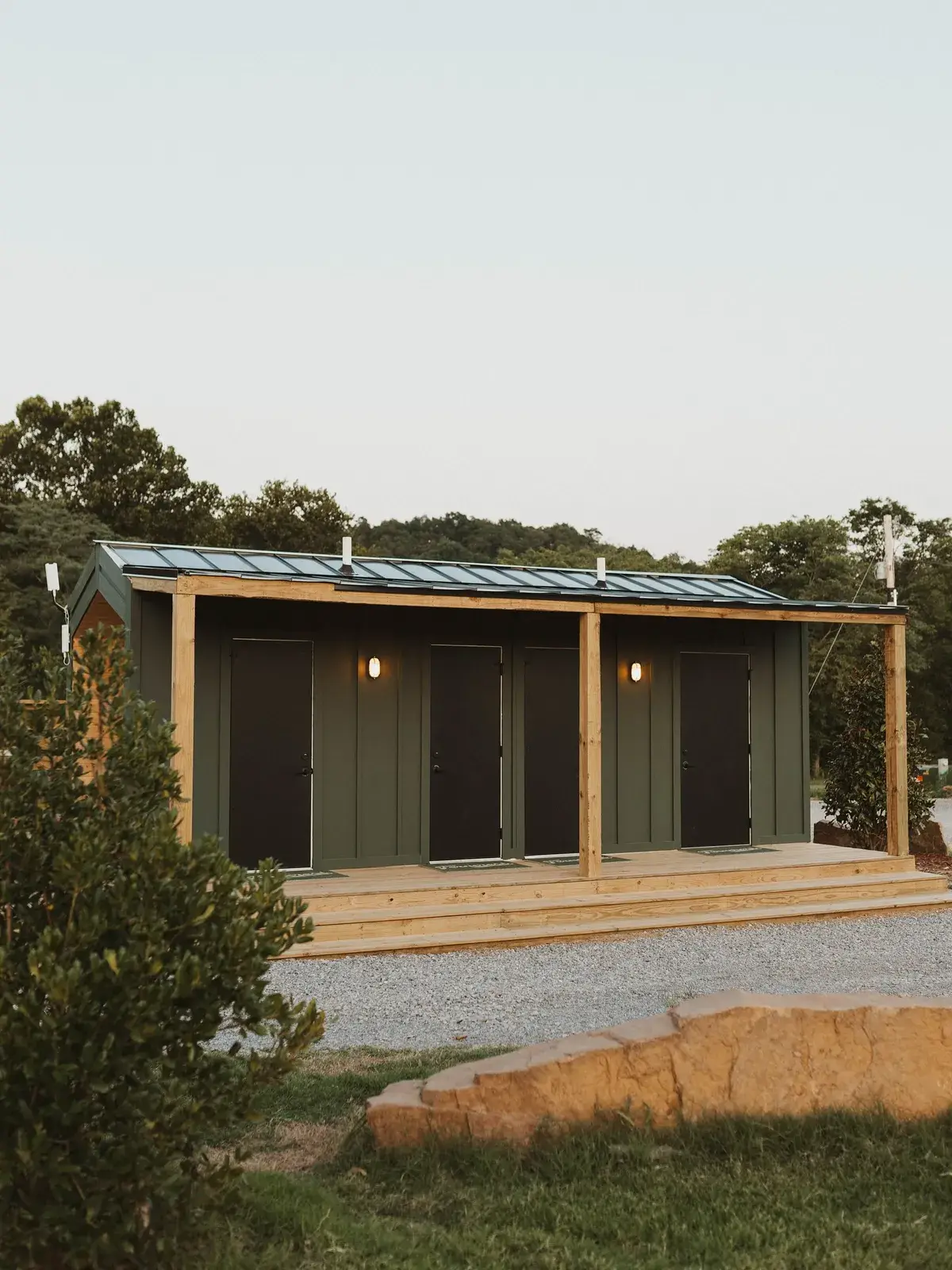
The Bath Pod is the private-bath answer: drop one beside a cluster of domes and each guest gets a finished bathroom a few steps from the tent, without you trenching a sewer line to every unit. The mobile bathhouse is the shared answer for common areas and larger fields, with multiple private stalls under one roof. Both are plumbed to fixtures a guest recognizes as lodging, not camping. A word on tanks, because it is where honesty separates the products: a single-stall Bath Pod can run fully self-contained on its onboard tanks, serviced on a routine interval, while a multi-shower bathhouse fills its tanks far too fast for that to be practical and is designed for the standard water and sewer connections instead. The right servicing model follows the fixture count, and the mechanics of those hookups are the subject of our mobile bathhouse hookups guide.
One thing we do not do, and counsel every buyer against, is hardwiring or hard-plumbing a mobile bath permanently into building utilities. Doing that can change how a local authority classifies the unit, from movable equipment to a permanent structure, which reopens the very zoning and permitting questions the mobile approach was chosen to avoid. Standard RV-style connections keep the unit what it is.
How many domes can one bath serve?
For a private cluster, plan on one Bath Pod for up to three nearby units. That ratio keeps the bathroom genuinely close to each tent and, in practice, gives a two-adult booking a bath that never has a line. Families push occupancy higher, so if a cluster routinely sleeps more, treat three units as the ceiling and step down from there.
For shared capacity around common areas, size to the morning, not to the code minimum. The reason is throughput: showers are the fixture that spikes, because a whole property rises and wants hot water in the same two-hour window, and a facility can carry plenty of toilets yet still produce a shower line. Federal water figures give you a planning anchor for that window, since a standard showerhead moves about 2.5 gallons per minute and an efficient one no more than 2.0, which sets both your stall throughput and your tank draw.[3] A four-shower unit serves roughly twenty sites at its ceiling and closer to ten to twelve where mornings feel effortless. The full peak-load method, with the inputs written out, is in the bathhouse sizing guide.
Whichever ratio you land on, confirm the legal minimum with your county health department first. State fixture schedules like Michigan’s scale required toilets and lavatories to your site count, and that number is your starting line even though it is almost always below what keeps guests from waiting.[1]
Where to start
If you are adding domes or safari tents, decide the layout before the fixtures: private baths on the units you want to charge a lodging rate for, shared capacity where guests gather. Then match the structural path to how fast you need it and how much you expect the property to change. For most operators standing up an upscale outdoor-hospitality property on a season’s timeline, a delivered self-contained bath removes the permitting-and-construction project while keeping the finished-bathroom result, and it can be repositioned or added to as the property grows.
Working through a specific property? Configure a Bath Pod or a mobile bathhouse and see transparent, distance-based delivery in Build & Price. Planning a new property from raw land rather than adding to an existing one? Start at landowners and new operators, where the conversation begins with your site layout instead of a fixture schedule. And if a bigger shared bathhouse is on the table, the sizing guide is the next thing to read.
Pine does not provide tax, legal, or investment advice, and sanitary, accessibility, and permitting requirements are set by your jurisdiction. Confirm them with your state licensing agency and county health department before you build.
Frequently asked questions
- Do glamping domes come with a bathroom?
- Almost never. A geodesic dome or safari tent is sold as a shelter: a frame and a cover, sometimes with a deck, heat, and furniture, but no plumbing. Water, waste, and a toilet are the operator’s responsibility to add separately. The exception is a small number of premium tents pre-plumbed for an ensuite, and even those still need a water source and a waste path built to them.
- What are my options for adding a bathroom to a dome or tent?
- Four, in practice: a shared bathhouse the whole cluster walks to, private plumbing run to each unit, a composting or portable toilet as a stopgap, or a delivered self-contained bath that connects like an RV. They differ most in permits, site work, and guest experience, not in the fixtures themselves. A shared or delivered bath is where most upscale operators land.
- How many domes can one bathroom serve?
- A single private bath, such as a Pine Bath Pod, comfortably serves up to three nearby units, which lets a small cluster share a finished bathroom without plumbing run to each tent. For a larger gathering area or a whole field of sites, a multi-stall mobile bathhouse is the better fit. The binding constraint is showers, not toilets, because shower demand concentrates into the two hours after sunrise.
- Can I just use a composting toilet?
- You can, and for a rustic or remote operation it is a legitimate answer that needs no water or sewer connection. The tradeoff is guest experience: a composting or portable unit solves compliance without delivering the finished, private bathroom an upscale guest is paying a lodging rate to get. It works best as a stopgap while you plan a permanent path, or on deliberately primitive sites priced accordingly.
- Do I need permits and a foundation to add a bathroom?
- It depends entirely on the path. Site-built plumbing and a permanent bathhouse mean building permits, a foundation, and trenched water and sewer, a project measured in months. A self-contained mobile bath needs no foundation or building permit for the structure itself and connects through a standard RV-style power, water, and sewer hookup, so it can be operating within days. Confirm fixture minimums and permitting with your county health department, since those are set locally.
- Is a shared bathhouse or a private bath better for a dome property?
- Private where guests sleep, shared where they gather. A private bath attached to a dome cluster is much of what separates a camping rate from a lodging rate, so it is worth the investment on your premium units. Shared bathhouses still earn their place near common areas and firepits, where they absorb social peaks. Many properties run both.
Sources
- Michigan Admin. Code R. 325.1571, service buildings; required facilities (campground fixture schedule). Legal Information Institute, Cornell Law School.
- Handwashing facts and statistics. U.S. Centers for Disease Control and Prevention.
- WaterSense showerheads (flow-rate and water-use figures). U.S. Environmental Protection Agency.
- Composting toilets, water efficiency technology fact sheet (EPA 832-F-99-066). U.S. Environmental Protection Agency.
- Outdoor Recreation Satellite Account, U.S. and States, 2023. U.S. Bureau of Economic Analysis.
This paper draws on Pine’s experience manufacturing, delivering, and observing self-contained baths and bathhouses in operation across multiple climates, alongside cited federal and state sources on sanitation, water use, and campground fixture requirements. Fixture minimums, accessibility, and permitting are jurisdiction-specific; confirm them with your state licensing agency and county health department before you build.
Working through this for a specific property?
Build & Price