Pine whitepaper
Shared bathhouse or private bathrooms: which should your sites have?
A Pine whitepaper on the facilities decision every operator and landowner faces: give each site its own bathroom, or share. The answer turns on what you are selling, not on fixture counts.
The short answer, then the real one
Give a site its own bathroom when you are selling a lodging stay, and share facilities when guests are gathering or paying a camping rate. A private bath is the single feature that most cleanly separates a lodging rate from a camping rate, so it earns its place where the stay is premium and self-contained. A shared bathhouse is the better use of capital where people congregate, where the rate is lower, or where the property empties off-season. Almost every property we have worked with lands on a mix rather than one answer, and the useful question is where each one goes.
Private where they sleep, shared where they gather. Put a private bath with the premium stays that carry a lodging rate, and put shared capacity in the common areas where social peaks land. Most properties want both, in different places.
That is the short version. The rest of this paper earns it: what guests actually expect and how a private bath changes your rate card, how the two models load your housekeeping differently, how site mix and seasonality should steer the call, the water and servicing reality that quietly caps how private you can go, and finally how the decision maps onto the specific spaces and bath facilities you would deploy.
What guests expect, and what you can charge
The facilities question looks operational, but it is really a pricing question. In our experience, a private bathroom is the clearest line between a camping rate and a lodging rate. A guest who walks out of their own space into their own bathroom reads the stay as lodging and pays accordingly. A guest who crosses the property to a shared building, no matter how well appointed that building is, keeps the stay filed under camping in their own mind. The physical fixtures might be comparable. The category in the guest’s head is not, and the category is what sets the rate.
This is why the private-versus-shared decision cannot be made on construction cost alone. The right frame is what the choice unlocks on the rate card. A private bath attached to a premium space, like Pine Plus, tends to move that unit into a different pricing tier entirely, and that lift compounds every night the unit is booked. A shared bathhouse keeps even a beautiful cabin anchored at a camping-adjacent rate. Neither is wrong. They serve different products at different price points, and the mistake we see most often is pricing a stay as lodging while provisioning it as camping, or the reverse.
The useful test is to ask what you are selling before you ask what you are building. If the answer is a self-contained retreat people book for the privacy, the bathroom belongs with the stay. If the answer is a social, outdoor, value-forward experience where the firepit and the gathering space are the draw, a shared bathhouse fits both the budget and the guest’s expectations.
Housekeeping and turnover
Private and shared facilities do not simply cost different amounts to clean; they load your labor on different rhythms, and that rhythm is what an operator has to staff against.
A private bathroom turns over with the stay it belongs to. It is cleaned at checkout, as part of the unit turn, and the total cleaning load scales directly with how many private units you book. That is predictable and it is tied to revenue: every turn you are cleaning is a night you were paid for. The flip side is that private baths concentrate work into the checkout window, so a property that turns many private units on the same morning needs the crew to match.
A shared bathhouse runs on its own clock. It is typically cleaned a set number of times a day regardless of how full the property is, which makes the labor easy to schedule but means the facility has to hold up to a busy Saturday morning on the same staffing as a quiet Tuesday. The quality risk with shared facilities is not the deep clean, it is the midday state between cleans, which is a function of how many sites lean on a single building. Distributing shared capacity into several smaller bathhouses near the clusters they serve, rather than one central building, is the lever that keeps the between-cleans state acceptable, and it is covered in our companion paper on sizing campground bathhouses to peak demand.
Neither model is categorically lighter on labor. Private baths tie cleaning to bookings and concentrate it at checkout; shared baths make it a fixed daily routine that has to survive the morning rush. The right call depends on how your crew is scheduled and how your property fills, which is the next question.
Site mix and seasonality
How a property fills across the week and across the year should steer the facilities mix as much as any guest-experience argument.
A property with a uniform product, a field of similar sites at a similar rate, is a natural fit for shared facilities, because demand is even and a well-placed bathhouse serves everyone without privileging one cluster over another. A property with a tiered product, a few premium stays alongside more value-oriented sites, almost always wants both: private baths on the premium tier to justify its rate, shared capacity for the rest. The facilities mix should mirror the rate card. Where the rates are flat, shared tends to win; where the rates are tiered, the premium tier earns its private bath.
Seasonality pulls in the same direction. A property that runs hard in summer and empties in winter gets more out of shared capacity it can clean on a fixed routine and, if needed, close down in the off-season, than out of many private baths that each have to be winterized and maintained whether or not they are earning. A year-round property changes the math: private baths stay productive twelve months a year, and the four-season performance of the sleeping space becomes central, which we cover in what makes a mobile cabin genuinely four-season. The shorter and more peaked your season, the more a shared model tends to pencil; the longer your season, the more a private bath pays back.
The water and servicing reality
There is a physical constraint underneath the pricing and labor arguments that quietly decides how private you can practically go, and it is worth understanding before you plan a layout.
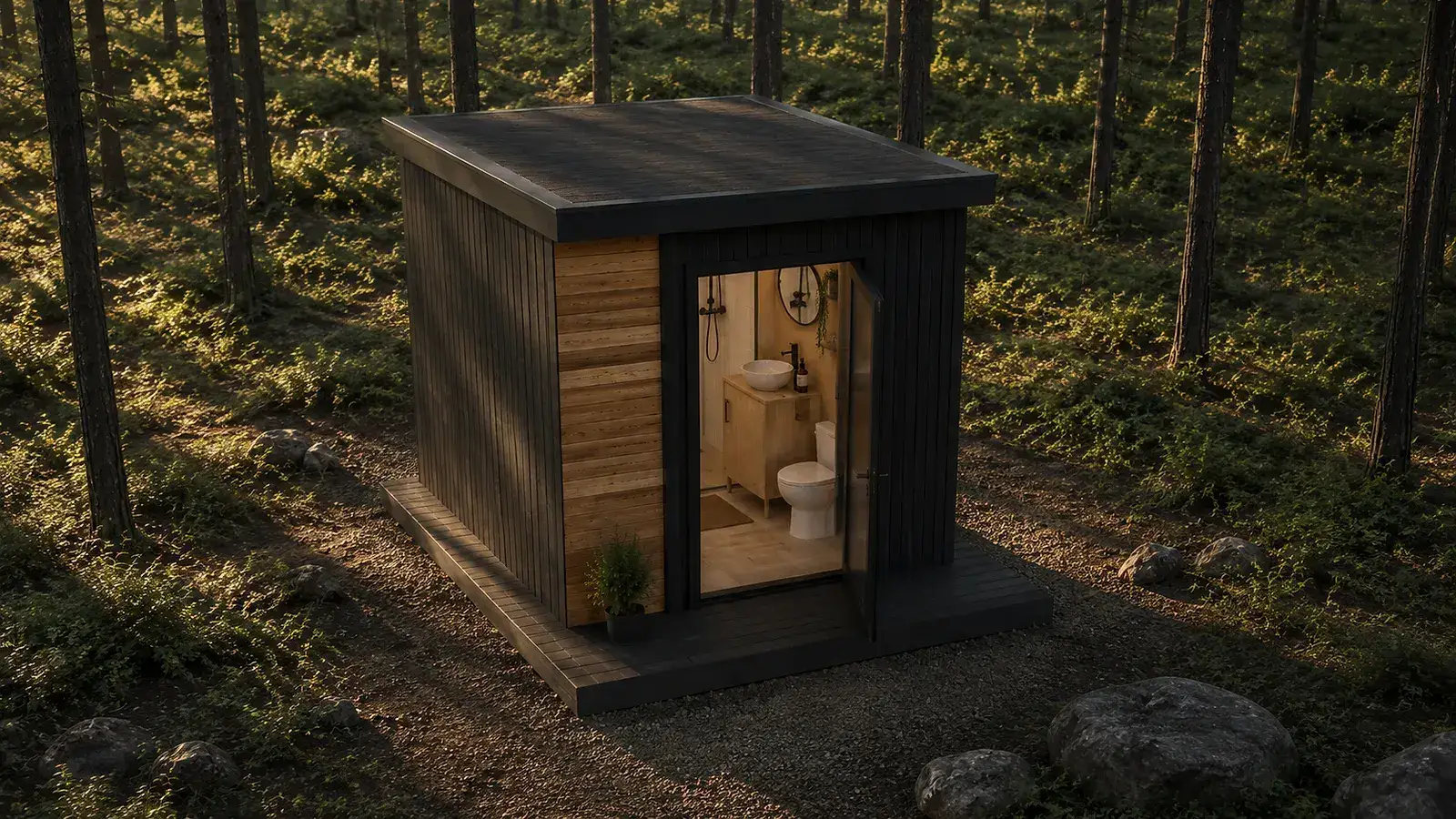
A private bath that serves a small cluster can run self-contained on onboard tanks. Our Bath Pod is built for exactly this: a self-contained private bath and shower space, with roughly one hundred gallons of tank capacity that we customize to the buyer’s requirements, serving a small cluster of nearby sleeping spaces, up to about three. Serviced on a routine interval, it needs no plumbing built into the ground. That is what makes a private cluster-bath practical on raw or lightly serviced land: the water comes and goes with the unit, not with a trench.
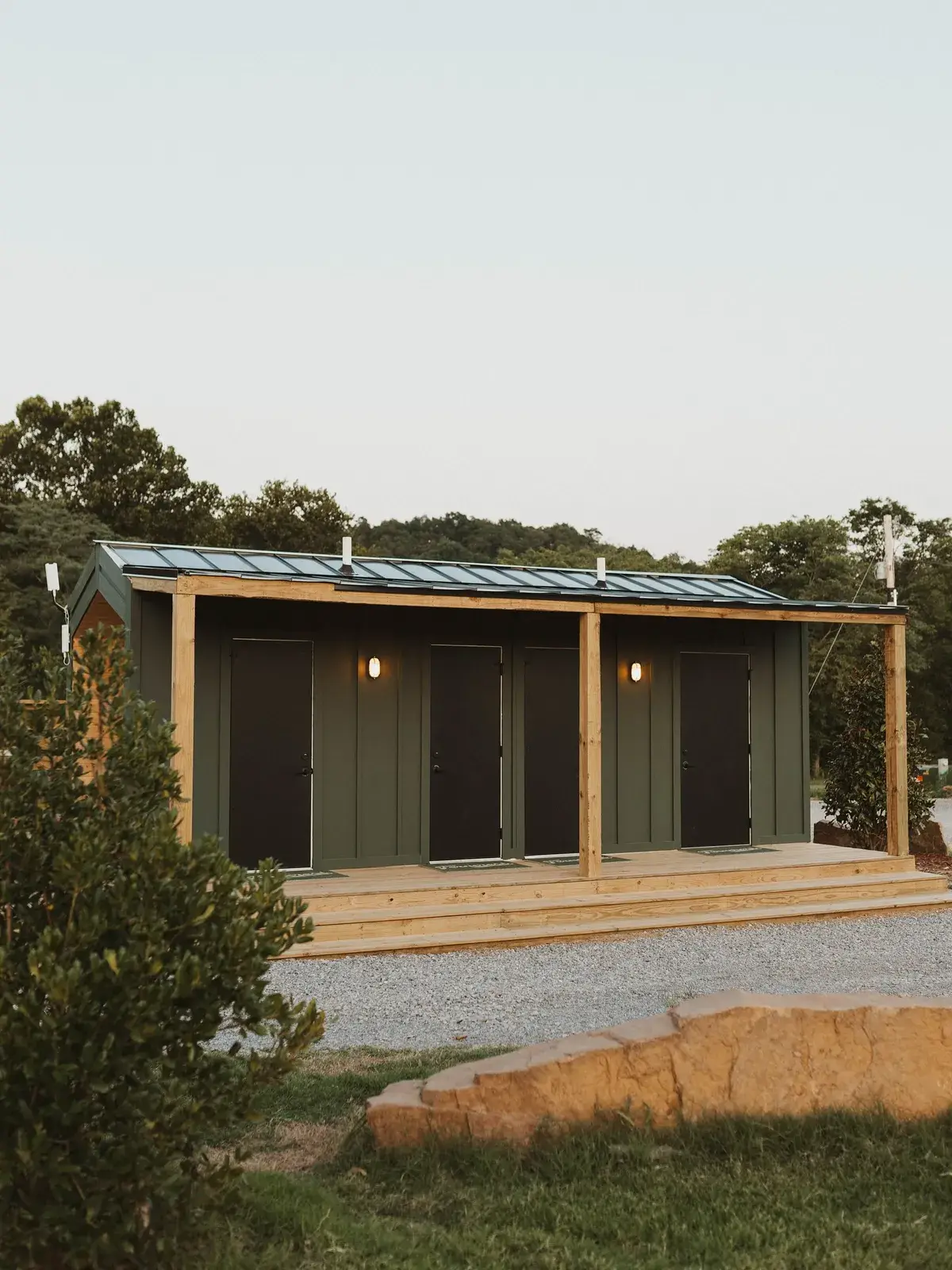
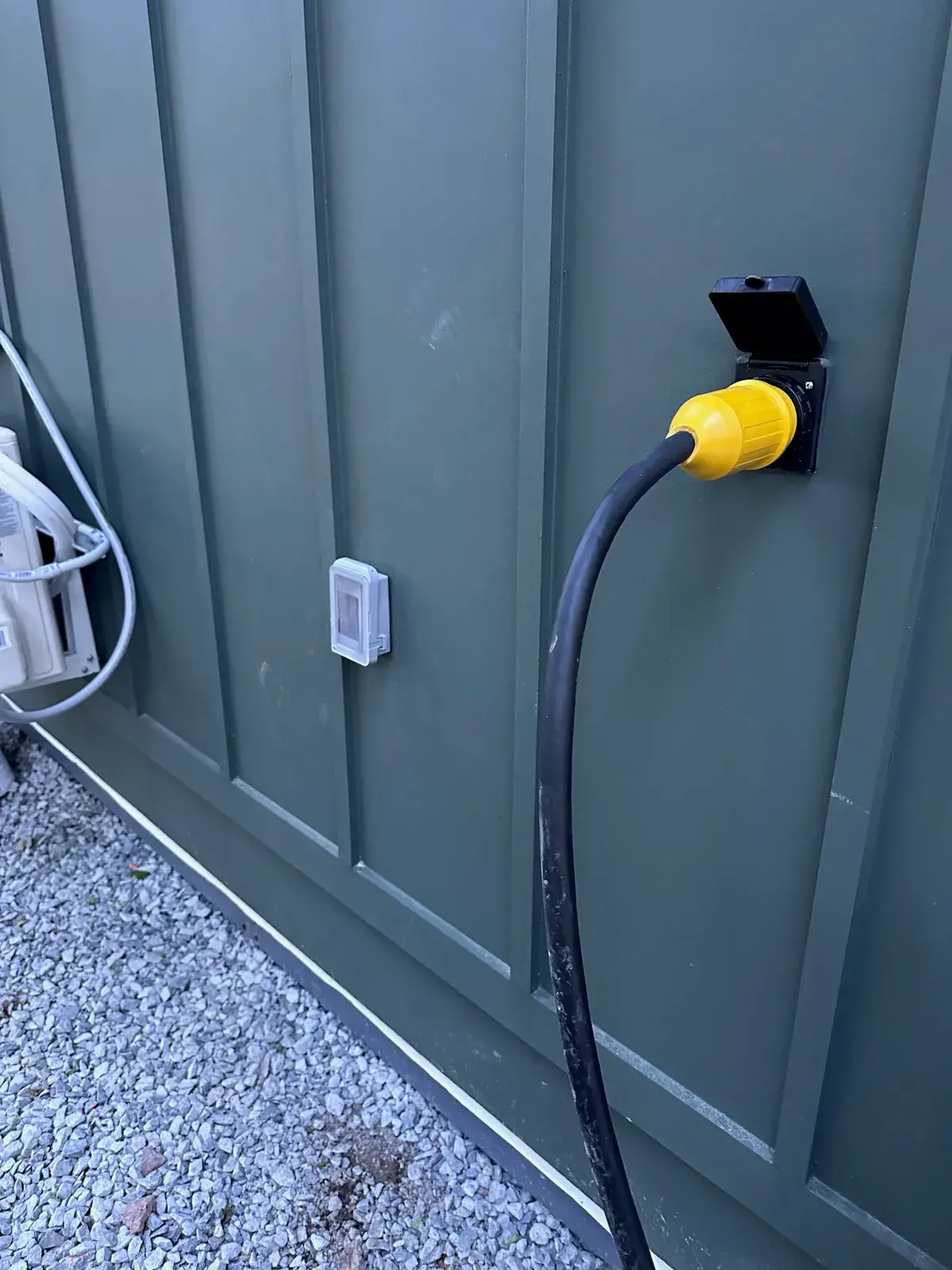
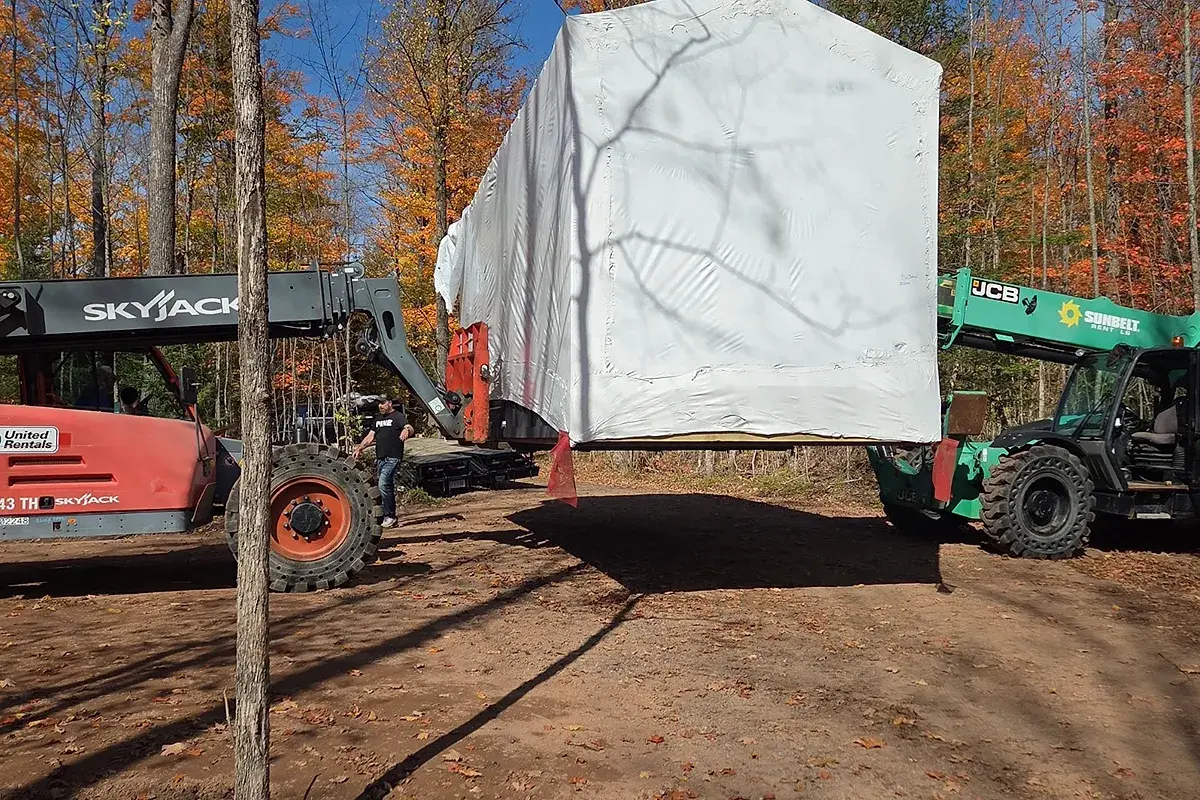
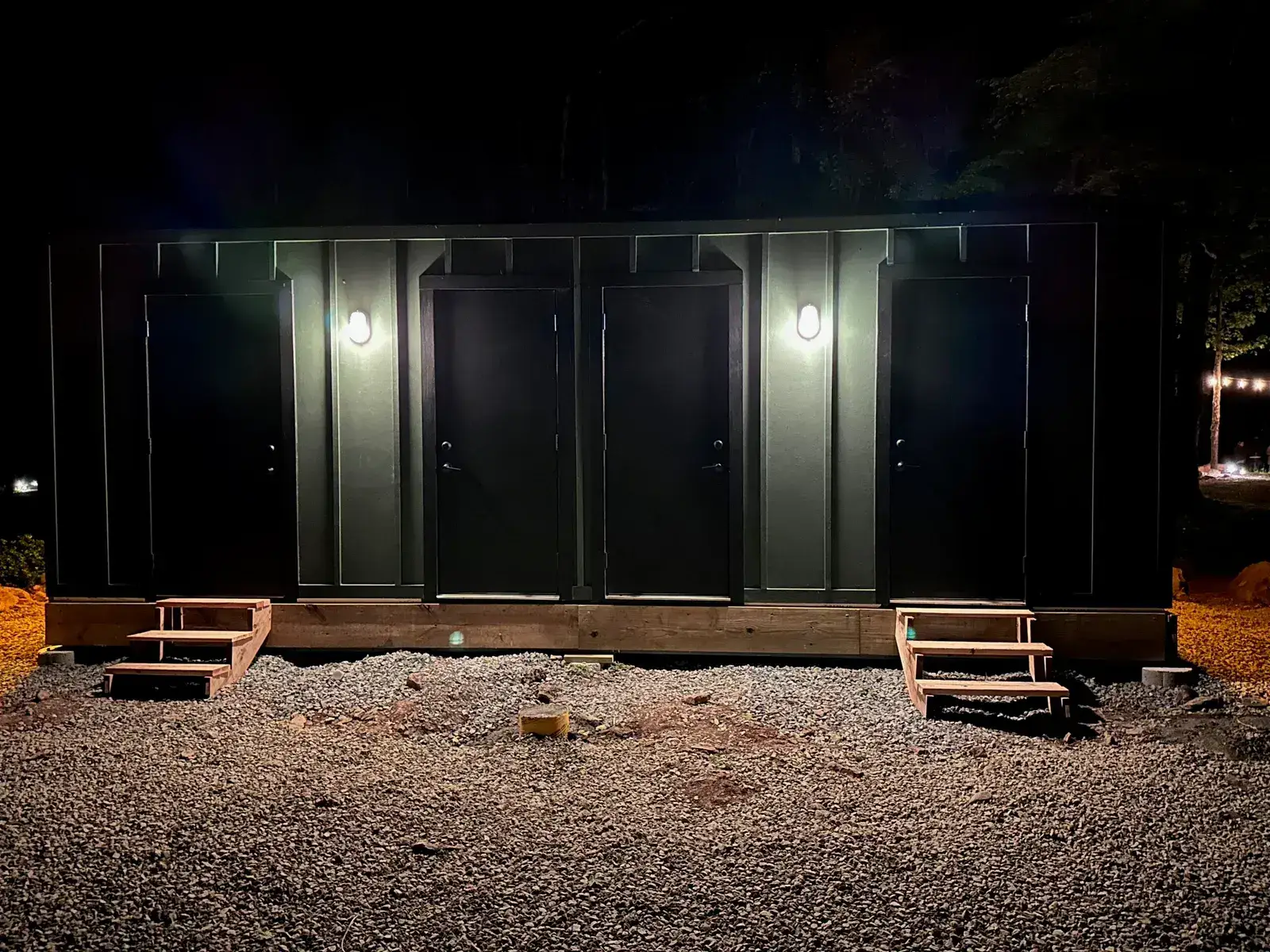
Shared capacity at scale is a different problem. A multi-stall facility carries far more showers, and showers are the fixtures that empty a fresh tank and fill a waste tank fastest. At that volume, onboard tanks would need servicing too often to survive a busy weekend, so a larger Mobile Bathhouse is designed to connect like a recreational vehicle instead: a standard water connection, a standard power connection, and standard RV-style sewer connections that come off the back of the unit and use the same pump-truck connectors every RV property already knows. If your property already hosts RVs, it already has what a shared bathhouse needs, and the unit can be operating within days of arriving. How these spaces are built and connected in the shop is the subject of our build process paper.
The practical takeaway: tanks make private, cluster-scale bathrooms possible almost anywhere, while shared, high-volume facilities want real connections. Match the servicing model to the fixture count, and the facilities plan tends to resolve itself. Regulatory requirements around water and waste are set locally, so confirm them with your jurisdiction as you plan.
Mapping it to the spaces
The decision becomes concrete once it is mapped onto the actual spaces, because each model exists to answer a specific version of the private-versus-shared question.
| Space | Bathroom model | Best for |
|---|---|---|
| Pine Plus | Private full bath, built in | A fully independent lodging stay at a lodging rate |
| Pine Camp | No private bath, shares a bathhouse | A mid-size stay with a kitchenette where the rate stays value-forward |
| Pine Pod | No plumbing, shares a bathhouse | The most compact sleeping space, paired with shared facilities |
| Bath Pod | Private bath on onboard tanks | Giving a small cluster, up to about three sleeping spaces, a private bath |
| Mobile Bathhouse | Shared multi-stall, RV connections | Shared capacity for a field of sites or a gathering area |
Read down that table and the paths are clear. Pine Plus is the fully independent option: private bath, kitchenette, no shared facility required. Pine Camp and Pine Pod deliberately do not carry a private bath and are built to share one; the Pod has no plumbing at all, which is part of what keeps it the most compact and affordable sleeping space. To give a group of Pods or Camps a private bathroom without moving each one up to Plus, you add a Bath Pod to the cluster. And where many sites or a gathering area need capacity, a Mobile Bathhouse provides shared multi-stall facilities that connect like an RV. Every one of these runs the same operational layer, Innkeeper, so the physical property reads off the booking calendar you already keep.
Private where they sleep, shared where they gather
The single principle that resolves most of these decisions is to put private facilities where guests sleep and pay a lodging rate, and shared facilities where they gather. It holds across property sizes and it keeps the facilities plan honest about what each dollar is doing.
The mental model we offer operators is a vacation rental. A three-bedroom house with one well-appointed bathroom hosts a family comfortably for a week, and no one calls it under-provisioned, because the bathroom belongs to them. A dedicated bath does the same for a cluster of sites. You are not sizing shared facilities against a morning peak; you are giving a small group a private bathroom that happens to be served by one unit. That is the Bath Pod case, and it changes the economics, because the privacy is much of what separates a camping rate from a lodging rate.
Shared facilities do not disappear under this principle; they relocate. They move to the common and gathering areas, the lodge, the pool, the event lawn, where social peaks land and where a multi-stall Mobile Bathhouse absorbs them well. A property that gets this right feels effortless to a guest: the bathroom is private when they are retreating and present when they are gathering, and they never think about it, which is the point.
When each path wins
To make the call concrete, here is where each model clearly wins in the properties we have worked with.
A private bath wins when you are selling a premium, self-contained stay and want the rate to reflect it; when the property runs year-round, so a private bath stays productive in every season; when guests are paying for privacy and would read a walk to a shared building as a downgrade; and when the sites are spread out enough that a shared bathhouse would mean a long walk in a robe. For a single independent unit the answer is Pine Plus; for a small cluster it is Pods or Camps paired with a Bath Pod.
A shared bathhouse wins when the product is value-forward and social, and a camping rate is the right rate; when the season is short and peaked, so capacity you can clean on a fixed routine and close in the off-season beats many baths to winterize; when sites are dense enough that one well-placed building serves a whole cluster with a short walk; and when you are adding capacity to an existing park and want it operating within days rather than built into the ground. That is the Mobile Bathhouse case, and the peak-demand sizing paper covers how to scale it.
Most properties, in the end, want both, and the sequencing is forgiving. Because Pine spaces are delivered and titled rather than poured into a foundation, you can open with shared capacity and add private baths as demand and rates justify, or start private on a premium tier and add shared capacity at the gathering areas. Operators planning an existing park should start at campgrounds and resorts; landowners planning a new property from the ground up should begin with a layout conversation at landowners and new operators, where the private-versus-shared question is best answered site by site rather than once for the whole property.
Working through this for a specific property? Build & Price lets you place private and shared facilities against your own site plan and see how the mix comes together.
Frequently asked questions
- Should every campsite or cabin have its own bathroom?
- Not necessarily. A private bathroom is what separates a lodging rate from a camping rate, so it earns its keep where you are selling a premium, self-contained stay. Where guests are already congregating, at a lower rate, or on a seasonal property that empties in winter, a shared bathhouse is usually the smarter capital decision. The practical rule we use: private where guests sleep and pay a lodging rate, shared where they gather. Most properties end up with a mix rather than one answer for the whole site.
- Does a private bathroom actually let me charge more?
- In our experience, yes, and it is one of the clearest levers an operator has. A stay with its own bathroom reads to guests as lodging rather than camping, and it commands a lodging rate accordingly. A shared bathhouse, however well built, keeps the stay in the camping category in a guest’s mind. If your goal is to move a site up the rate card, a private bath is usually the single change that does the most work.
- What is the difference between a Bath Pod and a Mobile Bathhouse?
- A Bath Pod is a self-contained private bath and shower space that serves a small cluster of nearby sleeping spaces, up to about three, and runs on its own onboard tanks serviced on a routine interval. A Mobile Bathhouse is a larger shared multi-stall facility for a field of sites; because it carries many more showers, it connects like an RV through standard water, power, and sewer connections rather than running on tanks. The Bath Pod is the cluster-private answer and the Mobile Bathhouse is the shared-capacity answer.
- Which Pine spaces come with a private bathroom?
- Pine Plus is the fully independent model, with a private full bath and a kitchenette, so it needs no shared facility. Pine Pod and Pine Camp do not have a private bath and are designed to share a bathhouse: the Pod has no plumbing at all, and the Camp adds a kitchenette but still shares facilities. To give a cluster of Pods or Camps a private bathroom without going all the way to Plus, you pair them with a Bath Pod.
- Do private bathrooms increase my housekeeping work?
- They change its shape more than its total. Private baths turn over on the same schedule as the stay they belong to, so cleaning concentrates at checkout and scales directly with the number of private units. A shared bathhouse is cleaned on its own rhythm, usually a set number of passes a day regardless of occupancy, which is predictable to staff but has to hold up against a busy morning. Neither is automatically lighter; the right choice depends on how your crew is scheduled and how your property fills.
- Can I start with a shared bathhouse and add private baths later?
- Yes, and it is a common path. Because Pine spaces are delivered and titled rather than built in place, you can open with a shared Mobile Bathhouse serving a field of sites, then add Bath Pods to specific clusters or move guests up to Pine Plus as demand and rates justify it. Capacity is not welded into a foundation, so the facilities mix can track how the property actually fills instead of a one-time guess made before you opened.
This paper draws on Pine’s experience manufacturing and delivering sleeping spaces and bath facilities, and observing how operators run them across full seasons and multiple climates. It is planning guidance, not a regulatory determination: fixture minimums and accessibility requirements are set locally, so confirm them with your jurisdiction before you build.
Working through this for a specific property?
Build & Price