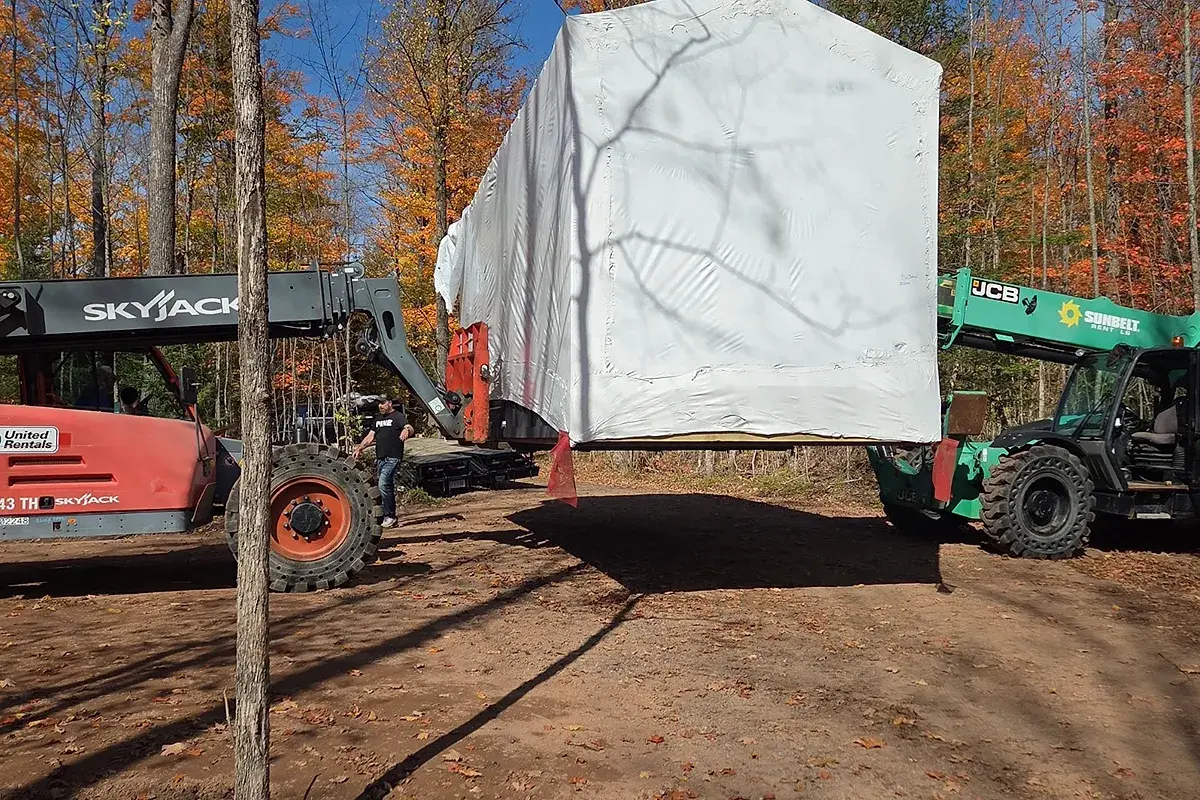
Pine whitepaper
Can you use a mobile cabin in all four seasons?
A Pine whitepaper on year-round performance: how residential-depth framing, high-end insulation, ducted climate control, and real freeze protection let a mobile cabin stay comfortable through a winter night and a July afternoon alike.
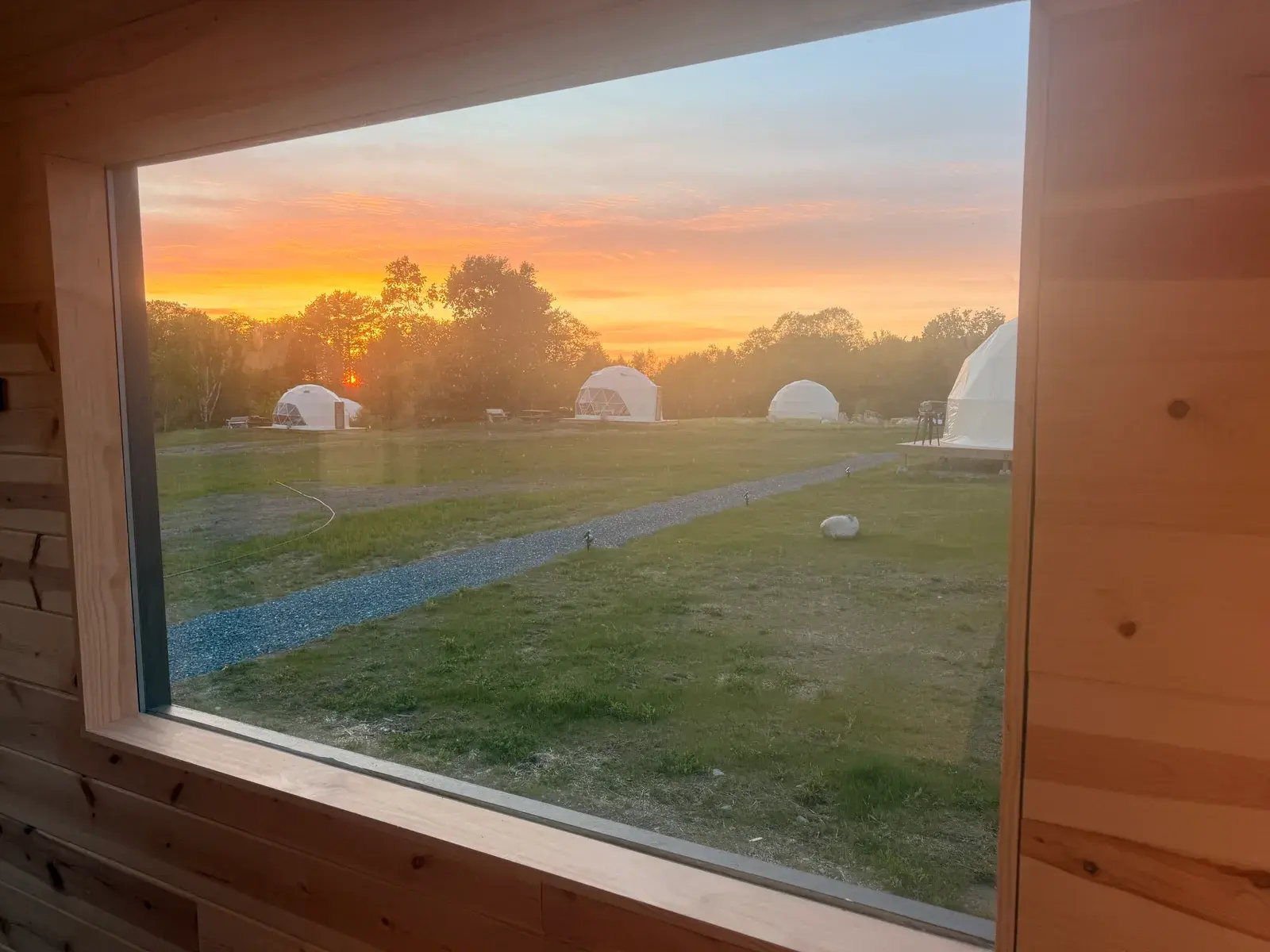
The short answer
Yes. A Pine mobile cabin is built for year-round use, not just the fair-weather months. It is framed and insulated to national residential insulation code rather than to the lighter standard typical of park-model or RV construction, it is heated and cooled by a ducted system instead of a seasonal one, and its plumbing is protected to keep water running through a hard freeze. Four-season performance is not a package you add later. In our experience it is decided in the shell, the climate system, and the plumbing, all before the cabin ever leaves our shop.
Residential-depth framing (2x6 walls, 2x8 floors, 2x10 ceilings) carrying insulation at roughly R-21 walls, R-30 floors, R-38 ceilings, one ducted air handler feeding every room, and plumbing kept in a conditioned space with heat tape and foam as backup. That combination is what lets the same cabin hold a winter night and a July afternoon.
The rest of this paper earns that answer. We walk through what four-season readiness actually requires, how the shell is framed and insulated, how one air handler keeps every room even, how the water stays liquid in a freeze, why the same build also carries the summer heat, and what a genuinely year-round cabin changes for an operator. The how-it-is-manufactured detail lives in a companion paper on how Pine cabins are built; here the subject is using the cabin across the seasons and why the build supports it.
What four-season actually means
"Four-season" is a claim a lot of outdoor accommodations make and far fewer earn. In practice it comes down to two separate problems that a cabin has to solve at the same time. The first is comfort: can the space hold a livable temperature when it is well below freezing outside, and again when it is hot and humid, without the climate system running flat out. The second is survival: can the cabin itself, and specifically its plumbing, come through a cold night unharmed so there is nothing to repair or re-commission in the morning.
A cabin built only for mild weather can look identical to a four-season one from the outside and fail both tests the first hard night. The difference is almost entirely in things a guest never sees: how deep the walls are, how much insulation sits inside them, how conditioned air is moved around, and where the pipes run. Pine designs for both problems at once, which is why the same cabin that we deliver to a northern property works just as well where the binding constraint is August rather than January.
It starts with the shell: framing and insulation
Everything about four-season comfort begins with the envelope, because a climate system can only hold a temperature the shell is able to keep. Pine builds to national residential insulation code, with framing cut to residential depth rather than the shallower cavities typical of park-model or RV construction: 2x6 walls, 2x8 floors, and 2x10 ceilings. Deeper framing is not a detail for its own sake. It is what creates room for serious insulation.
Into those cavities we build thick insulation batts at the high end of what the depth allows, reaching roughly R-21 in the walls, R-30 in the floors, and R-38 in the ceilings. R-value is simply a measure of how well a material resists heat flow, and higher is better in both directions.[1] The U.S. Department of Energy treats the building envelope, walls, floors, and roof, as the first place to invest for year-round comfort and lower energy use, because it is the barrier every other system depends on.[2]
The ceiling carrying the most insulation is deliberate: heat rises, and in both the heating and cooling seasons the roof is where a cabin gains and loses the most. The floor matters more in a mobile cabin than people expect, since the underside is exposed to outside air rather than sitting on a basement or slab; the 2x8 floor framing and R-30 batts are what keep the floor from feeling cold underfoot on a winter morning. The base of the cabin is finished with a concealed plinth, so there are no visible wheels and no open underside once the cabin is set in place.
The practical result is a cabin that behaves like a small, well-built house rather than a seasonal structure. More insulation and deeper framing than typical park-model or RV construction is the single biggest reason a Pine cabin holds its temperature through the extremes, and it is the foundation the rest of the four-season story is built on.
One air handler, ducted to every room
A well-insulated shell gives the climate system an easy job, and Pine does that job with a single overhead air handler housed in the utility room. From there, conditioned air, heated or cooled, is distributed to the rooms through 4-inch flex ducts. It is a deliberate departure from the common approach of bolting a separate mini-split head to the wall of each room.
The reason is comfort you can feel. A per-room wall unit conditions the room it is mounted in and leaves the rest of the cabin to drift, which produces the hot and cold rooms that make a space feel cheaply built. A single ducted system pushes the same conditioned air to every room, so the temperature is even from the bed to the bathroom, and it does it more quietly, with no unit cycling on the wall above where a guest is trying to sleep. In our experience, even, quiet heat and air conditioning is one of the clearest signals to a guest that a cabin was built properly, and it is one of the things that separates a Pine cabin from a seasonal structure.
The air handler living in the utility room also does double duty for the winter-water story below, because that conditioned space is what keeps the plumbing from freezing. One system, in one protected place, heats the rooms and the pipes together.
The winter story: keeping water running
Staying warm is half the winter problem. Keeping the water running is the other half, and it is the half that ends seasons for accommodations that were not built for it. A frozen line is not a comfort issue, it is a burst-pipe repair and a cabin out of service. Pine addresses it in three layers, in order of how much work each one does.
- A conditioned utility room. The primary defense is that the plumbing lives in the same heated space as the air handler. Whenever the cabin is being kept warm, the pipes are being kept warm, so under normal winter operation they simply never approach freezing.
- Heat tape as backup. We run heat tape along the pipes so that an unusual event, a deep cold snap or a door left open long enough to chill the space, does not catch them. It is the belt-and-suspenders layer: the room should be enough, and the heat tape is there for when conditions go past normal.
- Spray foam at the exterior walls. Any pipe that has to run near an exterior wall, the coldest part of the envelope, is sealed in spray foam, which both insulates the line and closes the air gaps where cold would otherwise reach it.
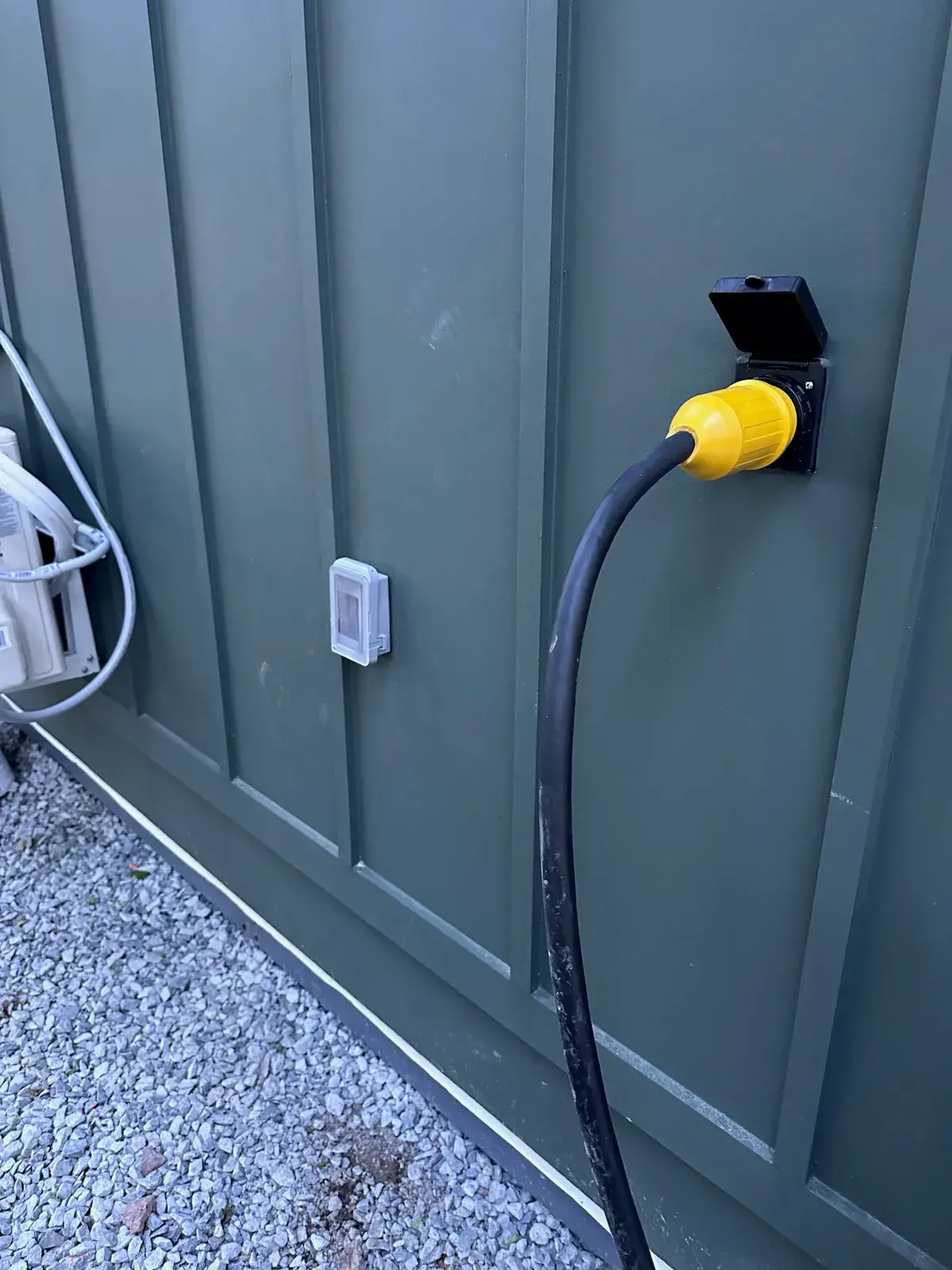
Taken together, the intent is a cabin a guest can use straight through winter without a drain-down routine or a shutdown each fall. That is a meaningful difference from accommodations that have to be winterized and closed, and it is the point where the build quality turns directly into operating months. The full connection detail, the standard garden-hose water inlet, the propane feed for the hot water heater, the 50-amp power, and the RV-style sewer connections, is covered in the companion papers on how Pine cabins are built and on how a mobile bathhouse hooks up.
The summer story: insulation cuts the load
Four seasons means the hot ones too, and the summer case is the same physics running in reverse. The insulation that holds heat inside through a January night is what keeps heat outside through a July afternoon. A shell at roughly R-21, R-30, and R-38 resists heat flowing in just as it resists heat flowing out, which means the air conditioning is working against a smaller load from the start.[1]
That smaller load shows up in two ways a guest notices. The cabin cools down quickly when someone arrives on a hot day, because there is far less heat stored in the walls and roof to pull out, and it holds its temperature without the system running constantly, because the heat it has removed is not pouring straight back in. The same ducted air handler that evens out the heat in winter moves cool, dehumidified air through every room in summer, so the whole cabin stays comfortable rather than just the room nearest a wall unit. A poorly insulated structure forces its air conditioner to run hard all afternoon and still lose ground once the sun is on the roof; a properly insulated one does not, and that is as true of a Pine cabin in August as it is in January.
What a longer season does for an operator
For an owner, the four-season build is not only a comfort story, it is a calendar story. A cabin that has to be winterized and closed earns during a window; a cabin built to run through the cold months is available to book whenever there is demand, including the shoulder weeks and winter stretches that a seasonal structure gives up. In our experience, the destinations that hold a guest through a snowy weekend or a crisp fall week are usually the ones whose accommodations were simply built to be comfortable then, and a guest rarely questions a rate for a stay that is genuinely warm and quiet when it is cold outside.
The weather-proofing has an operations dimension as well. A cabin that does not need to be drained and shut down is one less seasonal routine to schedule and one less thing to re-commission in spring, and plumbing that is built not to freeze is a repair that does not happen. For an operator weighing where a year-round build pays off, the pattern we see is consistent: the properties that stay open are the ones whose spaces were comfortable and dependable in every season to begin with. Operators planning this out can start from campgrounds and resorts or from landowners and new operators, depending on whether they are expanding an existing property or standing one up.
Choosing a model for year-round use
The four-season build, the framing, the insulation, the ducted air, and the freeze protection, is common to every Pine cabin. What differs between models is how self-contained a given cabin is through the cold months, and that follows from whether it carries its own plumbing.
The Pine Plus is the fully independent year-round stay: it has its own full bath and kitchenette, so everything a guest needs in winter, heat, water, a hot shower, is inside one protected cabin. The Pine Camp adds a kitchenette but shares a bathhouse, which makes the four-season performance of the shared bath space part of the plan as well. The Pine Pod is the smallest and carries no plumbing of its own, so it pairs with a bathhouse and leans entirely on its insulated, heated shell for comfort. All three are compared side by side on the mobile cabins overview, and the smart climate, lock, and monitoring hardware that reports a cabin's conditions back to the operator is covered on the hardware and network page.
Working through a four-season property for a specific site? Configure the model, the climate, and the layout in Build & Price, and the cabin that arrives is built for the season you need it in.
Frequently asked questions
- Can you use a mobile cabin in the winter?
- Yes. A Pine mobile cabin is built for year-round use. It is framed and insulated to national residential insulation code, with deeper wall, floor, and ceiling cavities than typical park-model or RV construction, and it carries a ducted heating system rather than a fair-weather setup. In our experience the two things that decide whether a cabin is genuinely winter-ready are the insulation in the shell and the protection on the plumbing, and both are built in before the cabin leaves our shop. Where a cabin may operate is set locally, so confirm that with your jurisdiction.
- Will the pipes freeze in a Pine cabin?
- They are built not to. The plumbing lives in a conditioned utility room that stays above freezing whenever the cabin is heated, which is the primary defense. As a backup, we run heat tape on the pipes so a cold snap or a door left open does not catch them, and we spray-foam around any pipe that runs near an exterior wall. The design intent is that a guest can keep water running through a hard freeze without a special winterizing routine.
- How is a Pine cabin heated and cooled?
- From a single overhead air handler in the utility room that distributes conditioned air through 4-inch flex ducts to the rooms. That is a deliberate choice over bolting a separate mini-split to each room: one ducted system delivers heat and air conditioning that is quieter and more even across the whole cabin, with no hot and cold rooms and no unit humming on the wall above the bed.
- Is a mobile cabin well enough insulated for extreme temperatures?
- A Pine cabin is framed with 2x6 walls, 2x8 floors, and 2x10 ceilings, and those cavities carry thick insulation batts at the high end of their depth, roughly R-21 walls, R-30 floors, and R-38 ceilings. That is more insulation and deeper framing than typical park-model or RV construction, and it is the foundation of true four-season performance: it holds heat in through a cold night and keeps heat out on a hot afternoon, so the climate system is not fighting the weather.
- Does a Pine cabin handle summer heat and humidity?
- Yes, and the same insulation that keeps winter heat inside keeps summer heat outside. A well-insulated shell means the air conditioning runs against a smaller heat load, so it cools the cabin faster and holds temperature without running constantly. The ducted air handler moves conditioned, dehumidified air evenly through every room rather than cooling only the room a wall unit sits in.
- Do you have to winterize and shut a Pine cabin down each fall?
- It is designed so you do not have to shut it down to protect it. Because the plumbing sits in a conditioned space with heat tape and foam as backup, a Pine cabin is built to keep operating through the cold months rather than being drained and closed. That is the difference between a seasonal rental and a year-round one, and it is the operator upside of a four-season build.
Sources
This paper describes how Pine designs and builds its mobile cabins for year-round use, drawing on our experience manufacturing and delivering them across multiple climates and full seasons. Insulation values are the high end of the framing cavities we build to and are stated as design targets, not a certification. Where a cabin may be placed and operated is governed locally; confirm requirements with your own jurisdiction.
Working through this for a specific property?
Build & Price